GREEN BATHROOM
🏠 20 Real Ideas
⏱ Quick Read
🔥 Always Trending
20 Green Bathroom Ideas
That Build a Cohesive Space
Without Overwhelming It
Green is having a genuine moment in bathroom design — and unlike many trend colors, it is earning that moment rather than simply occupying it. From the quietest sage to the most saturated emerald, green in a bathroom creates something that almost no other color achieves: a space that feels simultaneously calm and alive, designed and natural, considered and effortless. It is the color that makes a bathroom feel like a genuine retreat.
The challenge is always the same — how much green is enough, and how much tips the room into feeling dominated by a single color choice. These 20 green bathroom ideas answer that question with precision, giving you everything from the boldest statement possible to the most understated accent detail. I’ve noticed that the most successful green bathrooms are not the ones with the most green — they are the ones where the green is most intentionally placed. Every idea in this guide is designed with that principle at its center.
01
Sage Green Wall Tiles
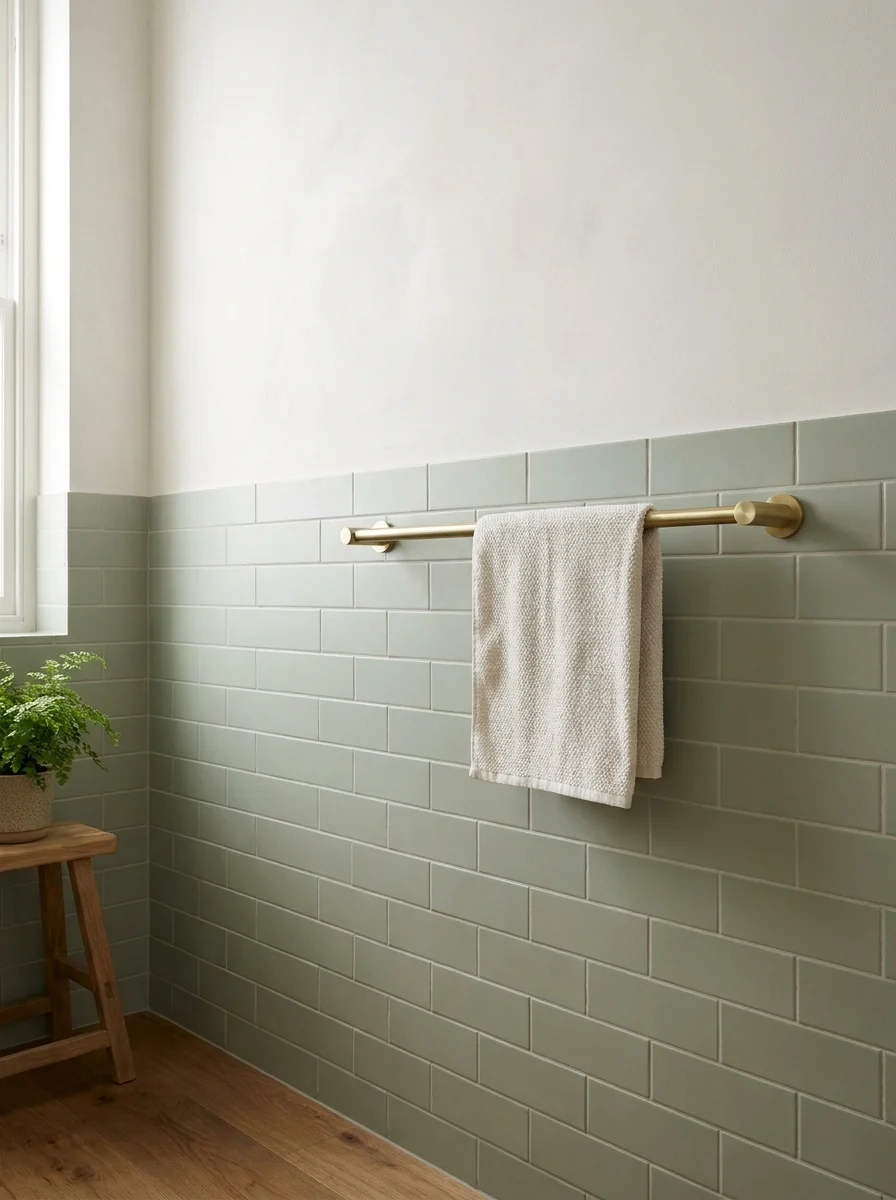
Sage green tiles are the starting point for a green bathroom that feels cohesive rather than chaotic, because sage is a tone that knows when to stop. It is green enough to be a genuine design commitment but desaturated enough to read as a sophisticated neutral — closer to weathered eucalyptus leaves than to a paint box. That restraint allows it to work with warm wood, white fixtures, and brass hardware without competing with any of them.
The finish of the tile matters as much as the color. A gloss sage green tile reflects light sharply and can make a bathroom feel smaller and more clinical. A matte sage green tile absorbs light softly, making the color appear slightly deeper and warmer, and giving the wall a quality closer to limewash paint than to a tiled surface. This single finish decision — matte over gloss — is often the difference between a green bathroom that feels spa-like and one that feels like a retro holdover.
The Key: Sage green matte tiles create the foundation of a green bathroom that works in every light condition — soft in morning daylight, warm and enveloping in evening lamplight. That versatility across the day makes it the most reliable green tile choice available
02
Forest Green Vanity Cabinet
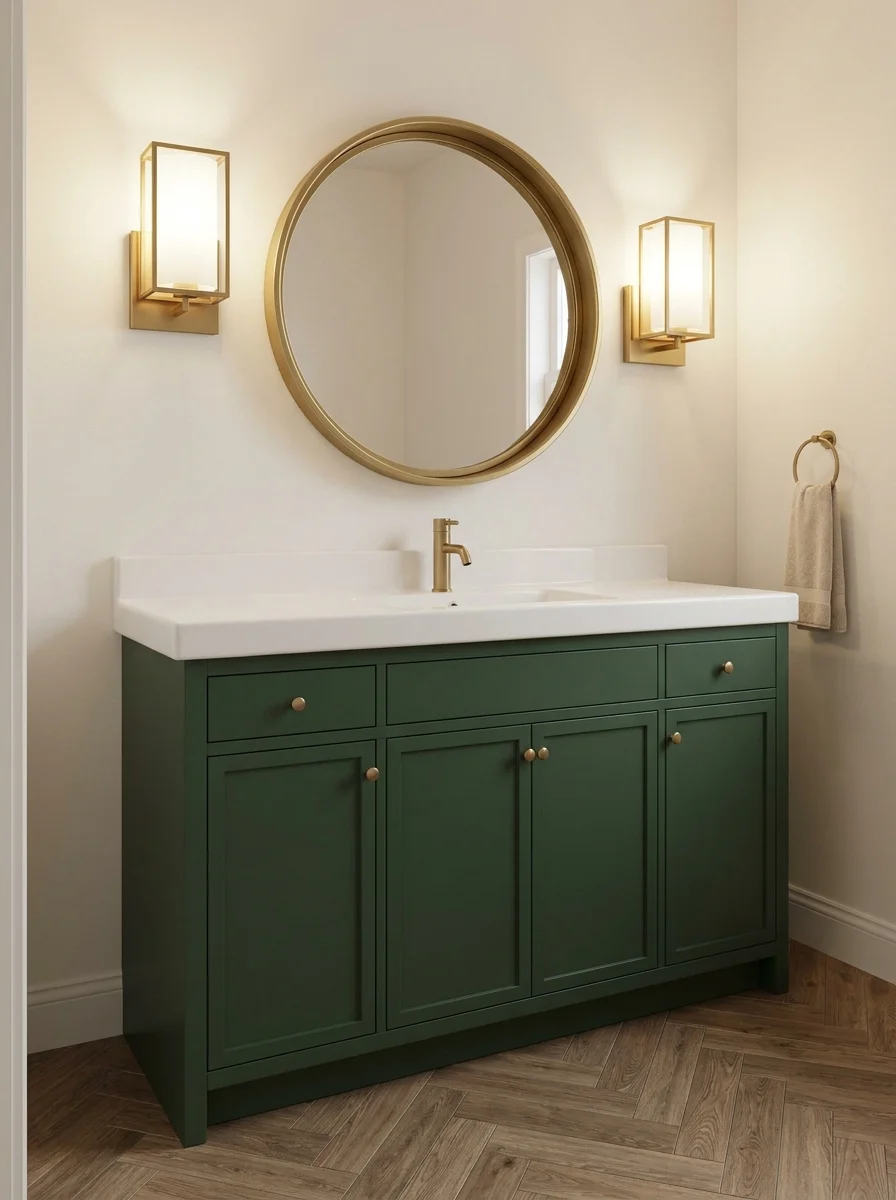
A forest green vanity cabinet treats the bathroom’s primary fixture as a piece of furniture — something with color, character, and visual presence — rather than a purely functional installation. The vanity becomes the room’s anchor, the element everything else orients around, and the green of its painted surface establishes the color story for the entire space without requiring green anywhere else.
The depth of forest green works particularly well in a bathroom because it creates a sense of roundedness and calms that lighter greens cannot always achieve. Against white walls and warm flooring, a forest green vanity reads as rich and sophisticated rather than heavy. People who are hesitant about committing to green often find that a painted vanity is the perfect entry point — it is a single piece that can be repainted if preferences change, but in practice, it almost never needs to be.
The Key: Concentrate the deepest green in the vanity and keep everything else lighter. This creates a visual hierarchy — one rich anchor piece, with everything else in support — that prevents the green from feeling overwhelming while still making a confident design statement.
03
Eucalyptus Botanical Shower Bundles
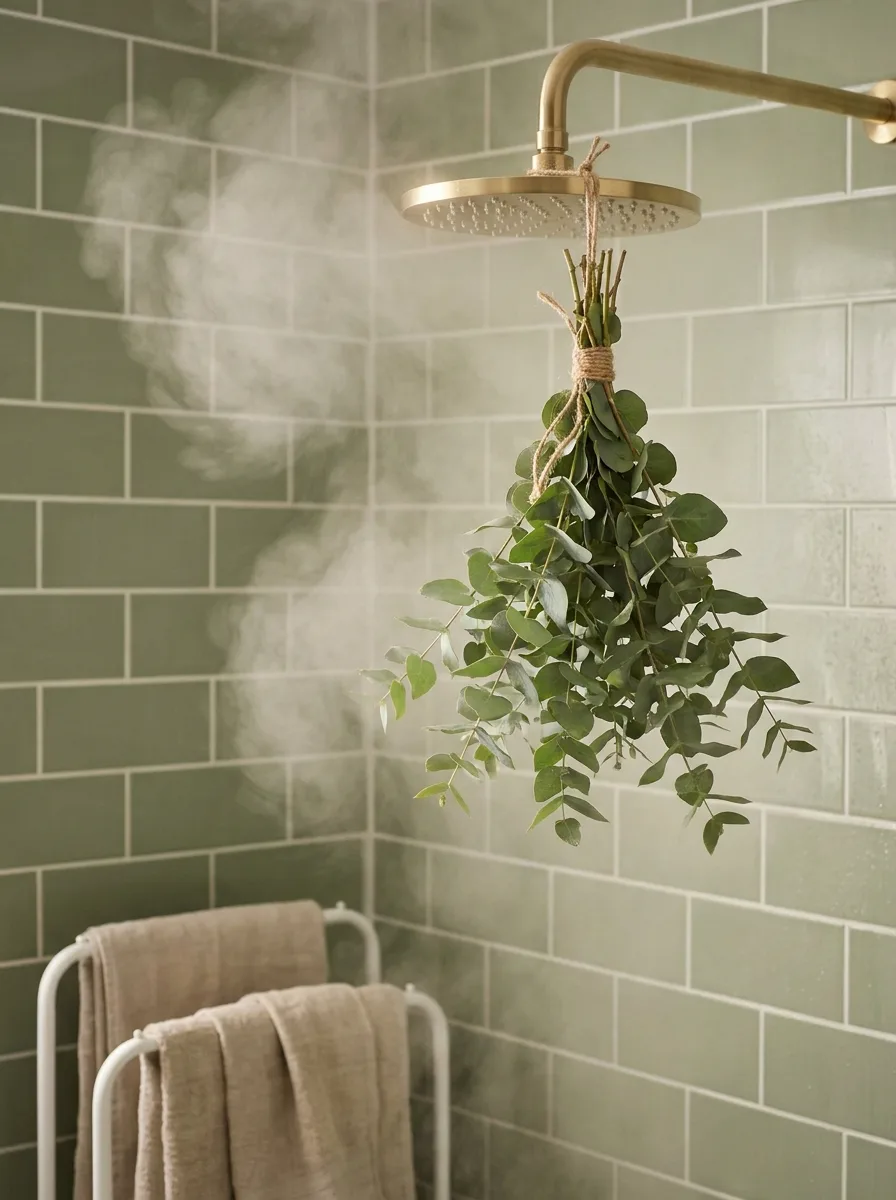
Fresh eucalyptus hung from a shower head delivers on every level simultaneously. It costs almost nothing beyond the eucalyptus itself, requires no installation, and fills the bathroom with a clean, fresh fragrance every time hot water runs. It looks genuinely beautiful against almost any tile color, but particularly against any shade of green, where the natural leaves read as a seamless extension of the room’s botanical palette.
A fresh eucalyptus bundle is not just a plant — in the context of a green bathroom, it is a bridge between the designed green of the tile or paint and the living green of the natural world outside. That connection between interior color palette and living botanical material is one of the subtlest and most effective ways to make a green bathroom feel genuinely cohesive rather than simply color coordinated.
The Key: The eucalyptus bundle connects the room’s designed green palette to living nature — and that connection gives a green bathroom its soul. It is the detail that makes the color feel intentional rather than arbitrary.
04
Emerald Green Accent Wall
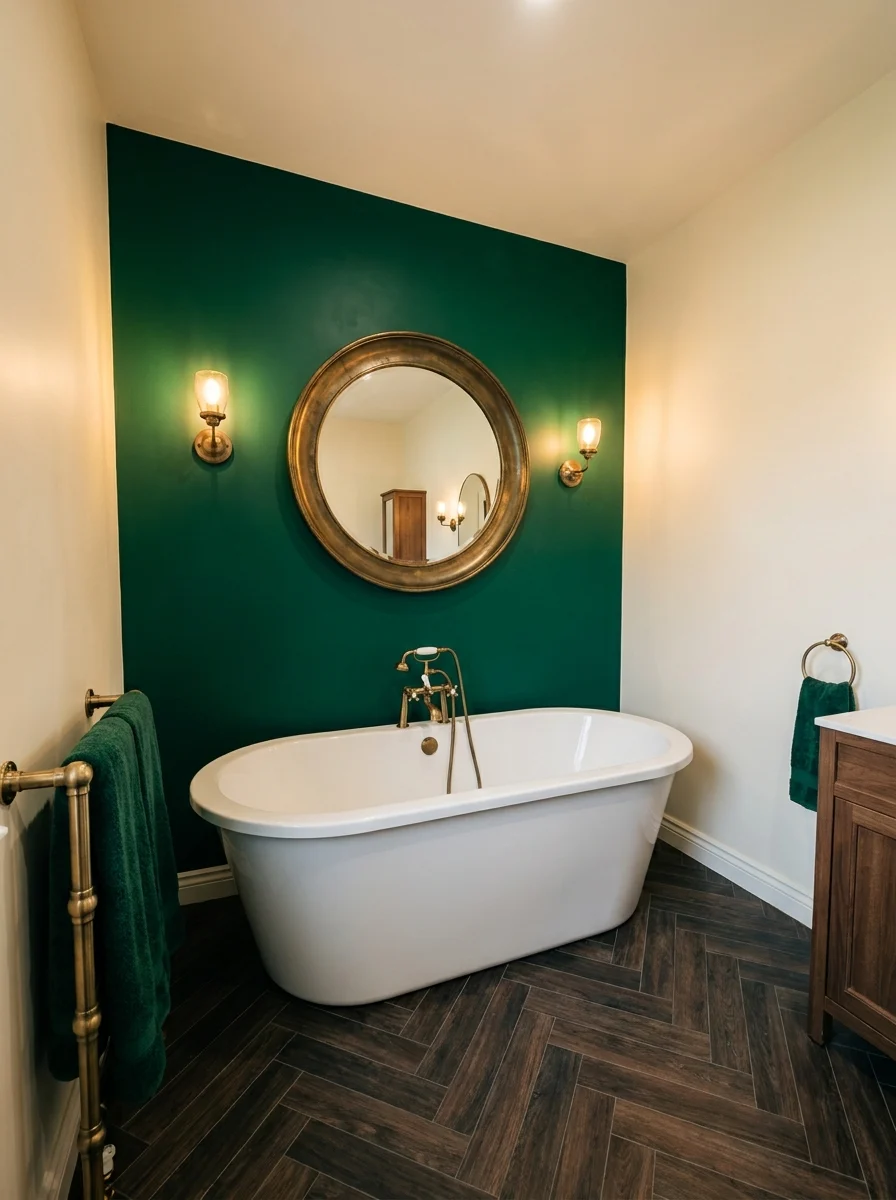
An emerald, green accent wall is a bold commitment that pays off in proportional measure — a bathroom with one deeply saturated green wall feels jewel-like and enveloping in a way that no softer approach can replicate. The key is the singular nature of the commitment: one wall, fully saturated, fully committed, with everything else held deliberately light. That contrast — deep jewel green against warm white — is what creates the drama.
The placement of the accent wall is the most important decision. The wall directly behind the bathtub is the most photographed angle in any bathroom, making it the highest-impact location for a color statement. A large round mirror in aged brass mounted on the emerald wall reflects the white of the opposite wall, bouncing light into the room and preventing the dark tone from making the space feel smaller.
The Key: One wall, fully committed, with three walls held completely neutral. That contrast ratio — 25% saturated color versus 75% warm white — is the formula that makes an emerald accent wall feel luxurious rather than oppressive.
05
Green, White Geometric Floor Tiles
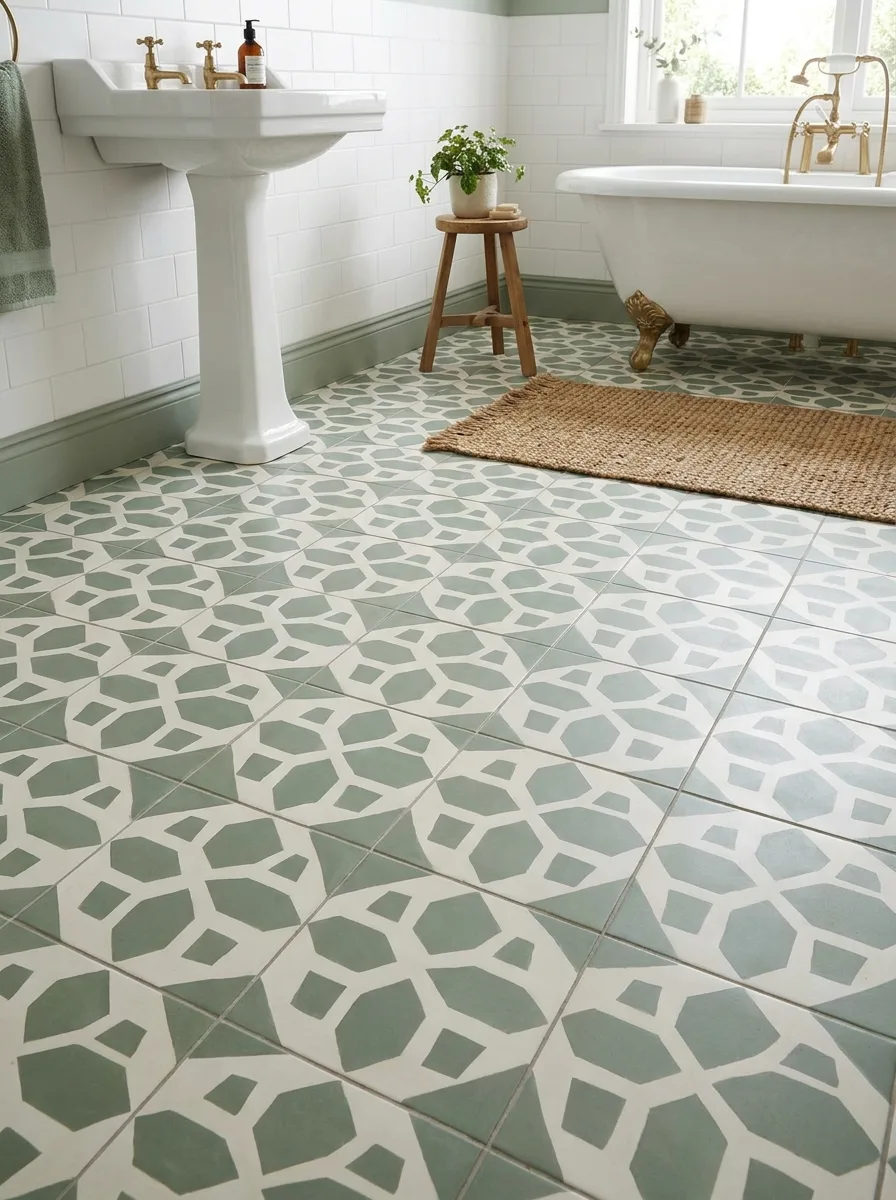
A green and white geometric floor tile is one of the cleverest ways to introduce green into a bathroom — it puts the pattern and color underfoot, creating visual interest without competing with walls, mirrors, fixtures, or any of the other elements that make up the primary visual field. Standing in the doorway, the floor pattern gives the room immediate character. Looking around from inside, the walls remain clean and calm.
Encaustic cement tiles carry advantages beyond their beauty. The slight texture of the cement surface is naturally non-slip, the matte finish absorbs light gently, and the handmade quality of genuine encaustic tiles means each one carries slight tonal variation that makes the floor look genuinely old and collected rather than freshly installed. A green and white encaustic floor can completely anchor and define a bathroom that is otherwise quite plain.
The Key: Pattern at floor level, calm at wall level. This hierarchy keeps a green and white geometric floor from overwhelming the bathroom while still delivering the full visual impact of a committed pattern choice.
06
Olive Green Lime Wash Paint
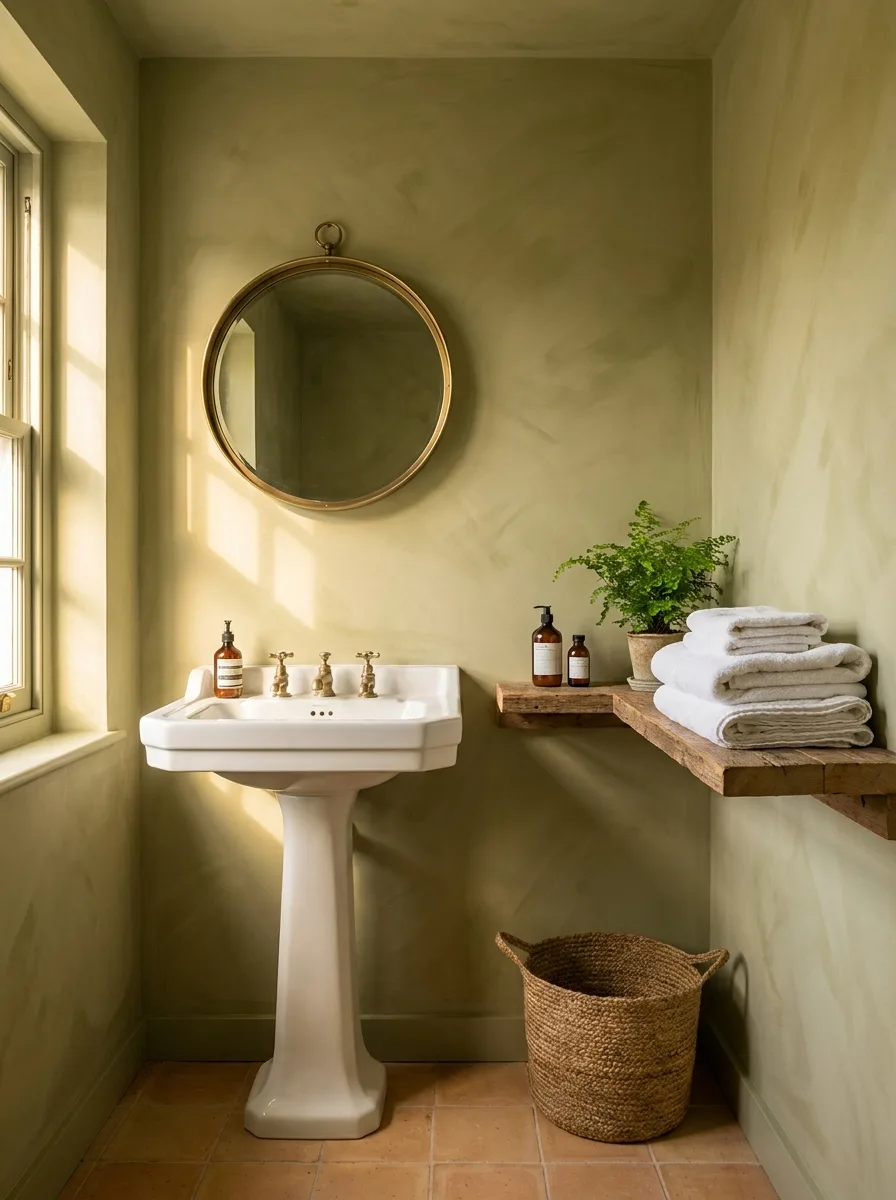
Olive green lime wash creates a bathroom wall that feels like it belongs to a different era — unhurried, handcrafted, deeply warm. The natural variation in the finish, where the olive tone deepens in the low areas and lightens where brush strokes overlap, gives the wall a complexity and depth that no flat painted surface can achieve. It looks different in morning light than in evening lamplight, and that changing quality makes the bathroom feel alive.
The breathability of lime wash is an important practical advantage in a bathroom. Unlike conventional latex or acrylic paint, lime wash is mineral-based and allows moisture vapor to pass through the wall surface rather than trapping it. This makes it genuinely better suited to bathroom environments than most people expect. Olive green lime washes in particular benefits from the bathroom’s warm, humid atmosphere, which makes the tonal variation appear richer and more varied.
The Key: Olive green lime wash creates warmth that sage cannot — it is deeper, earthier, and more complex in changing light. For bathrooms that lack natural light or warmth, it is the more effective green choice.
07
Brass and Green Hardware Pairing
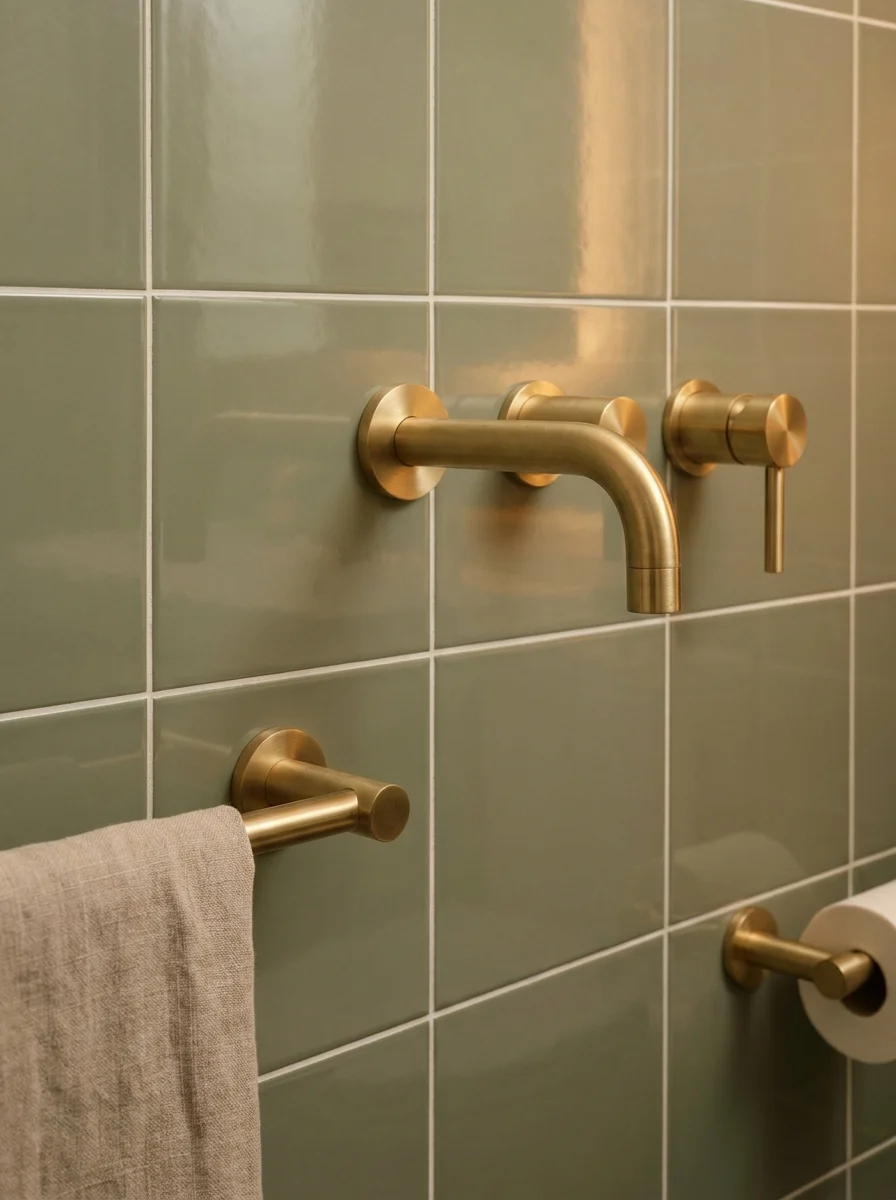
Hardware is the connective tissue of a green bathroom — the element that links the tile color to the vanity finish to the mirror frame to the towel rail into a single cohesive palette. In a green bathroom, brushed brass performs this connective function better than any other metal, because it shares the warm, organic quality of green’s natural associations — leaves, moss, patinated copper — rather than working against them.
The practical rule is total consistency. Every metal touchpoint in the bathroom — every faucet, every towel bar, every hook, every hinge — needs to be in the same finish. A single chrome element among brass fixtures creates a visual interruption that the eye returns to repeatedly and registers as a mistake. The most beautifully cohesive green bathrooms are almost always the ones where hardware consistency has been absolute.
The Key: Choose one metal finish and apply it everywhere without exception. In a green bathroom, brushed brass is that finish — and its total consistency is what transforms a collection of individual fixtures into a cohesive, designed space.
08
Live Edge Wood Floating Shelf
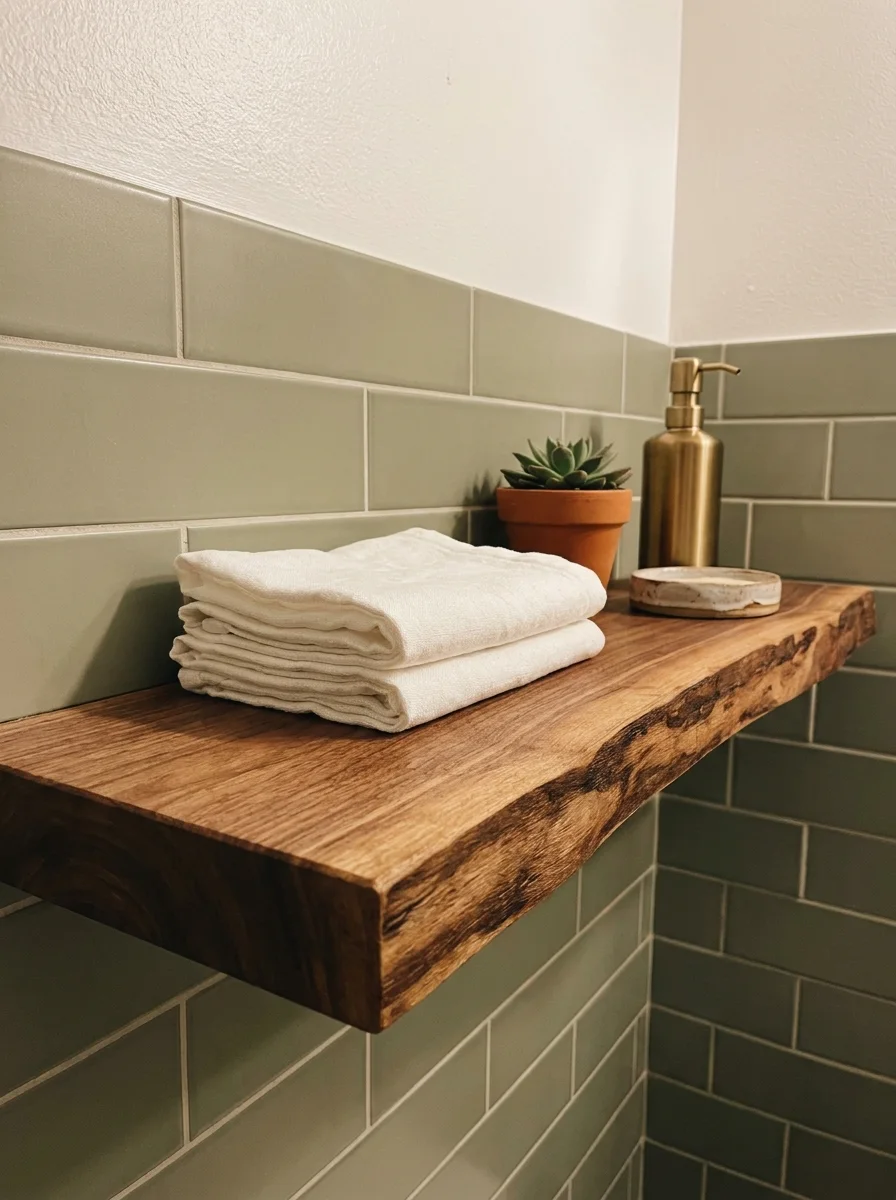
A live edge wood shelf in a green bathroom is a material choice that speaks the same language as the color it sits against. Green references nature — leaves, moss, forest, growth. A live edge shelf, with its natural irregular outline preserving the original edge of the tree, references exactly the same world. The two elements together create a bathroom that feels genuinely connected to the natural world rather than simply colored to suggest it.
The styling of the shelf is where cohesion is made specific. Folded white linen towels for contrast, one small plant for living botanical presence, one ceramic object for handcraft texture, and one brass element to tie back to the fixture palette — these four object types create a shelf that reads as curated and calm rather than cluttered or sparse. Live edge shelves styled this way become the most photographed and most commented-on detail in a green bathroom.
The Key: The live edge wood shelf is where material, color, and styling come together in the smallest possible footprint. Get this one surface right — organic wood, warm objects, restrained quantity — and it anchors the entire bathroom’s aesthetic.
09
Bottle Green Freestanding Bathtub
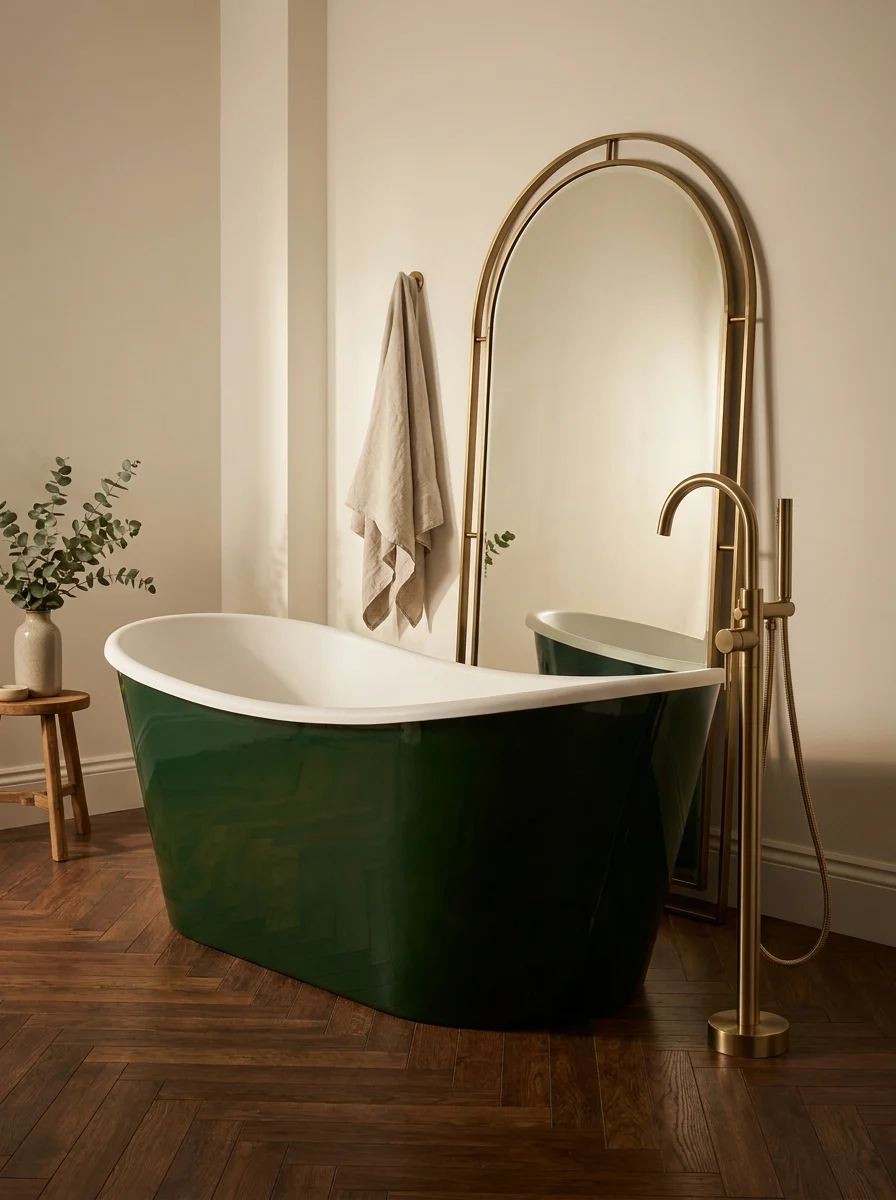
A bottle green freestanding bathtub is a once-in-a-design-decision purchase — the kind of element that defines the entire bathroom and everything else in the room organizes itself around. When the bathtub is the focal point, the walls can afford to be quieter, the floor can be simpler, and the accessories can be minimal, because the tub carries the full weight of the room’s visual drama by itself.
The color of the tub’s exterior — bottle green, deep and slightly blue-shifted, with a high-gloss finish — works in a bathroom with warm white walls because the contrast is clean and total. Green against white, gloss against matte, the sculptural roundness of the tub against the flat planes of the walls. This combination — a richly colored freestanding tub in an otherwise plain white room — photographs with the kind of immediate impact that makes visual sense.
The Key: When the tub is the hero, everything else is supporting cast. Keep walls white, floors warm but simple, and hardware consistent in brass — then let the bottle green tub do what it was born to do.
10
Potted Plants Indoor Greenery
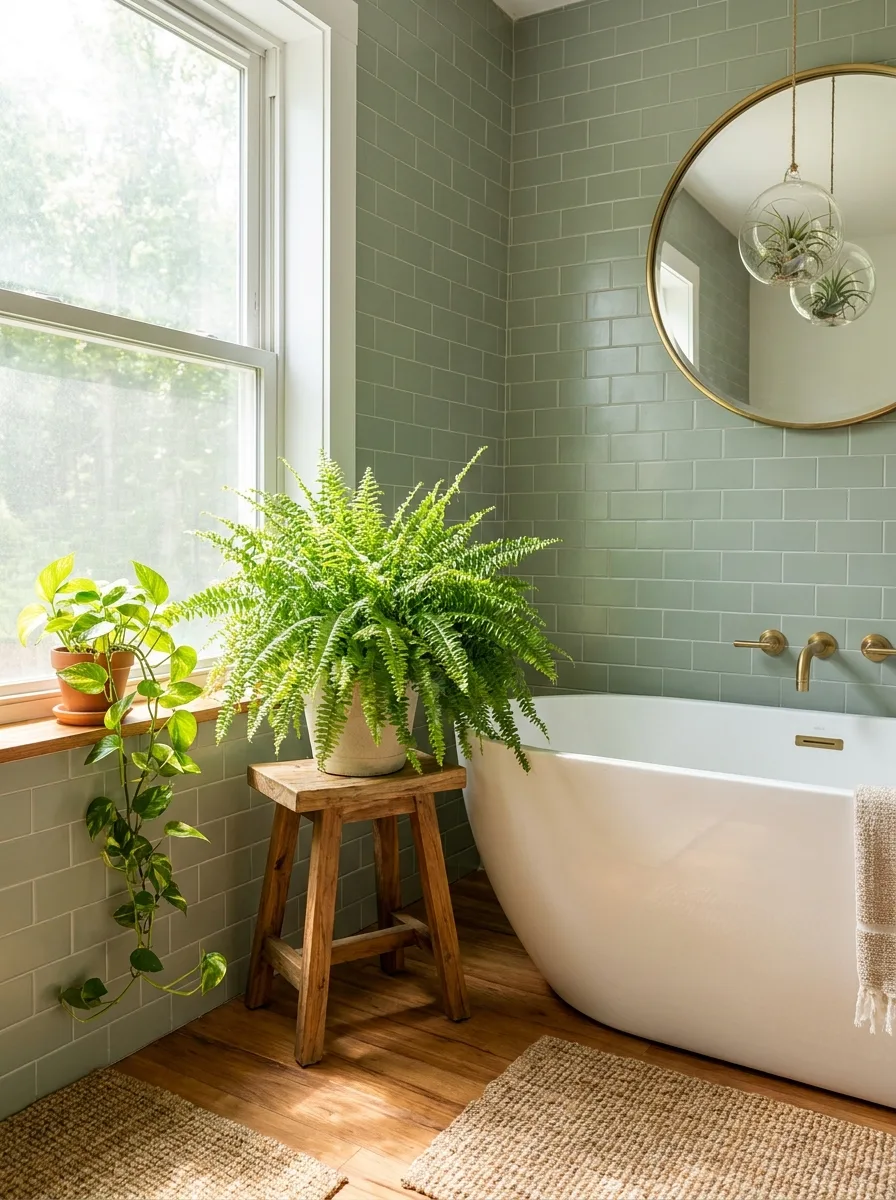
Living plants in a green bathroom create a layered botanical world — designed green in the tile or paint, living green in the plants, bridging the interior and the natural world in a way that makes the color choice feel genuinely motivated rather than merely decorative. The warm humidity of a frequently used bathroom is genuinely one of the best indoor environments for tropical and moisture-loving plants.
The layering of plant heights is the key to moving from one plant in a bathroom to a genuinely lush result. A large floor plant at the base, a smaller plant on the vanity or shelf at mid-height, and a trailing or hanging plant at eye level — these three levels create a botanical composition that fills the room’s vertical space and makes the bathroom feel genuinely immersed in greenery rather than simply accessorized with a plant.
The Key: Layer plants at three heights — floor, surface, and hanging. That vertical distribution creates a genuinely lush, immersive botanical quality that a single plant placed on one surface simply cannot achieve.
11
Dark Green Ceiling Moment
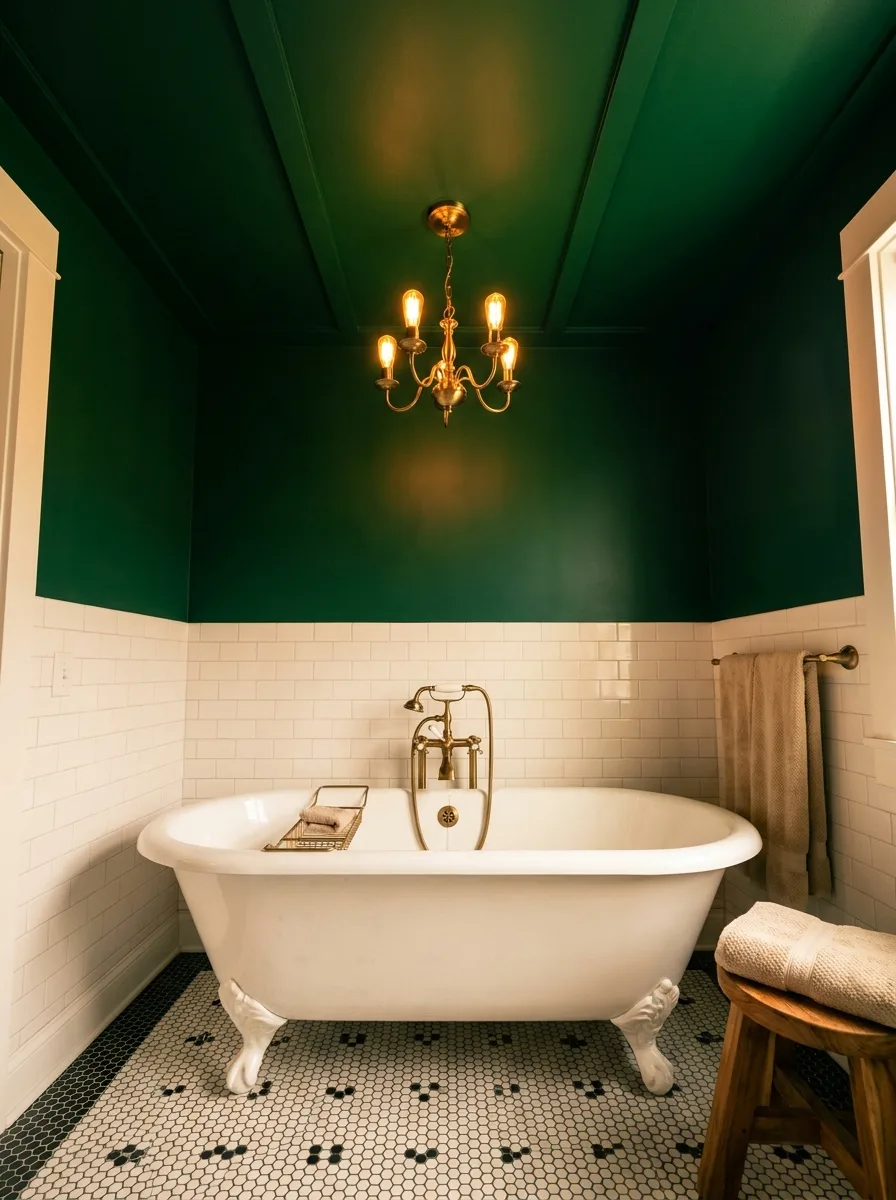
The ceiling is the most underused surface in bathroom design and the one most likely to create genuine surprise and delight when used thoughtfully. A deep green ceiling — hunter, bottle, or forest — creates the feeling of a canopy overhead, the same psychological effect as tree cover or a draped fabric ceiling. It is intimate without being claustrophobic, dramatic without being loud, and because the walls remain white, the room retains its brightness.
The lighting choice is critical. A small vintage-style chandelier or a simple brass pendant hung from a green ceiling frames the light source within the color, making the ceiling read as warm and intentional rather than dark and forgotten. A deep green ceiling with small warm light source mounted within it, and white walls below, can create some of the most genuinely atmospheric and surprising bathrooms imaginable.
The Key: One bold color on the ceiling with white walls below is the formula. The ceiling becomes a canopy, the room retains its brightness, and the surprise of looking up delivers a design moment that no amount of tile work on the walls could match.
12
Green Terrazzo Stone Vanity Top
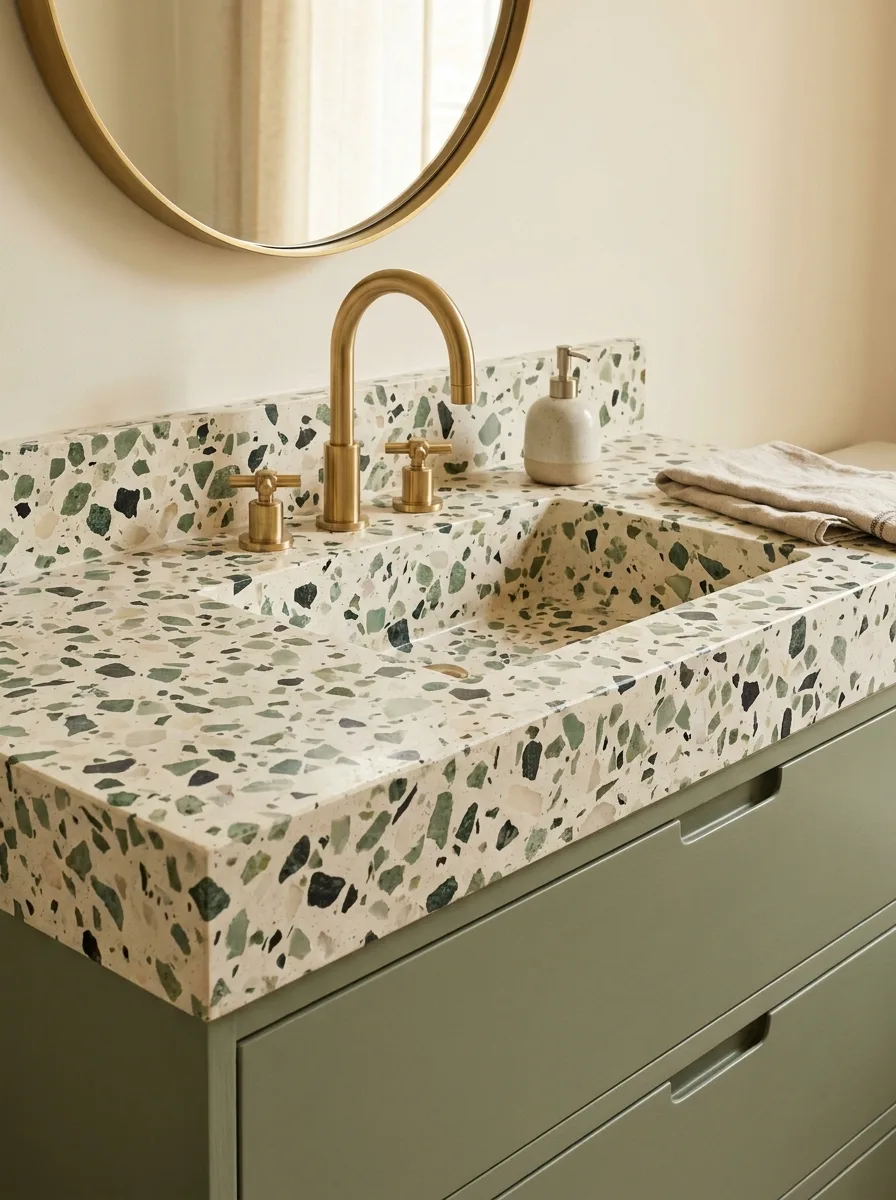
A green-chipped terrazzo vanity top introduces multiple scales of green simultaneously. The individual chips read as detailed pattern up close. The overall surface reads as warm, textured tone from across the room. That dual quality — detail and texture simultaneously — makes terrazzo one of the most visually interesting materials available for a green bathroom vanity.
The color combination within the terrazzo matters significantly. Green chips paired with black and white in a warm cream cement base creates a palette that is simultaneously bold and cohesive. The black grounds the green, the white lifts it, and the warm cream base ties the whole surface to the warm wood and brass palette of the rest of the bathroom. Terrazzo vanity tops in this color combination manage to feel both historic and completely contemporary.
The Key: Terrazzo delivers two layers of green simultaneously — detail and texture — that no single-color surface can match. The chip pattern creates visual interest at every distance and scale, making it the most versatile green surface choice for a vanity top.
13
Green Linen Towels Textiles
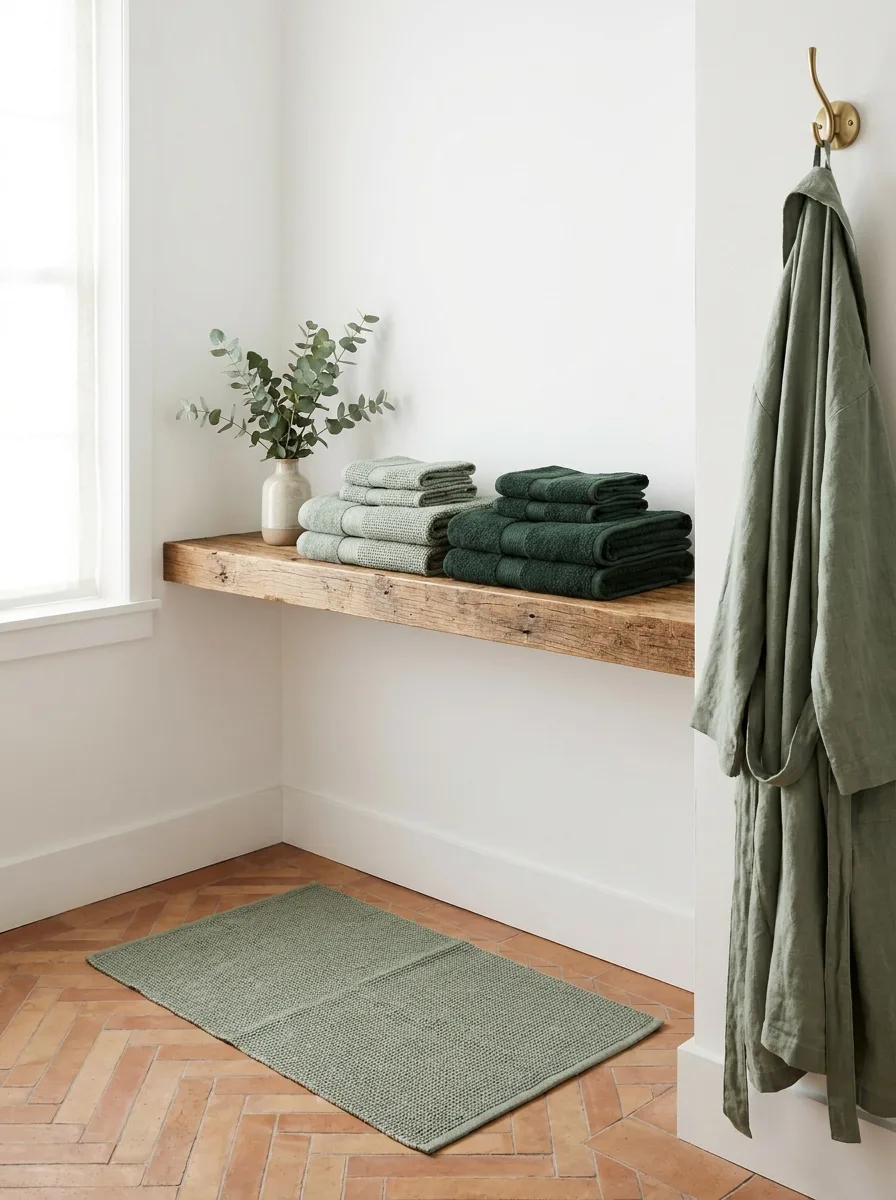
Green linen towels are the most accessible starting point for a green bathroom — they cost almost nothing relative to tile or cabinetry, they can be changed tomorrow if preferences shift, and yet in the right material and tone they add color, texture, and warmth with remarkable effectiveness. A folded sage green linen hand towel on a warm wood shelf punches well above its visual weight.
The material matters considerably. A green cotton terry towel adds color but little else. A green linen towel adds color, texture, and a certain considered quality — the slightly rumpled, lived-in softness of linen signals that this is a bathroom where beauty and function coexist naturally. Switching to linen towels, even in a completely unchanged bathroom, consistently makes the space feel more intentionally designed and more genuinely spa-like.
The Key: Two tones of green in the same warm family — one sage, one forest — creates layered textile depth that a single flat color cannot achieve. The lighter tone lifts, the darker grounds, and together they make the simplest bathroom shelf look genuinely styled.
14
Botanical Wallpaper Feature Wall
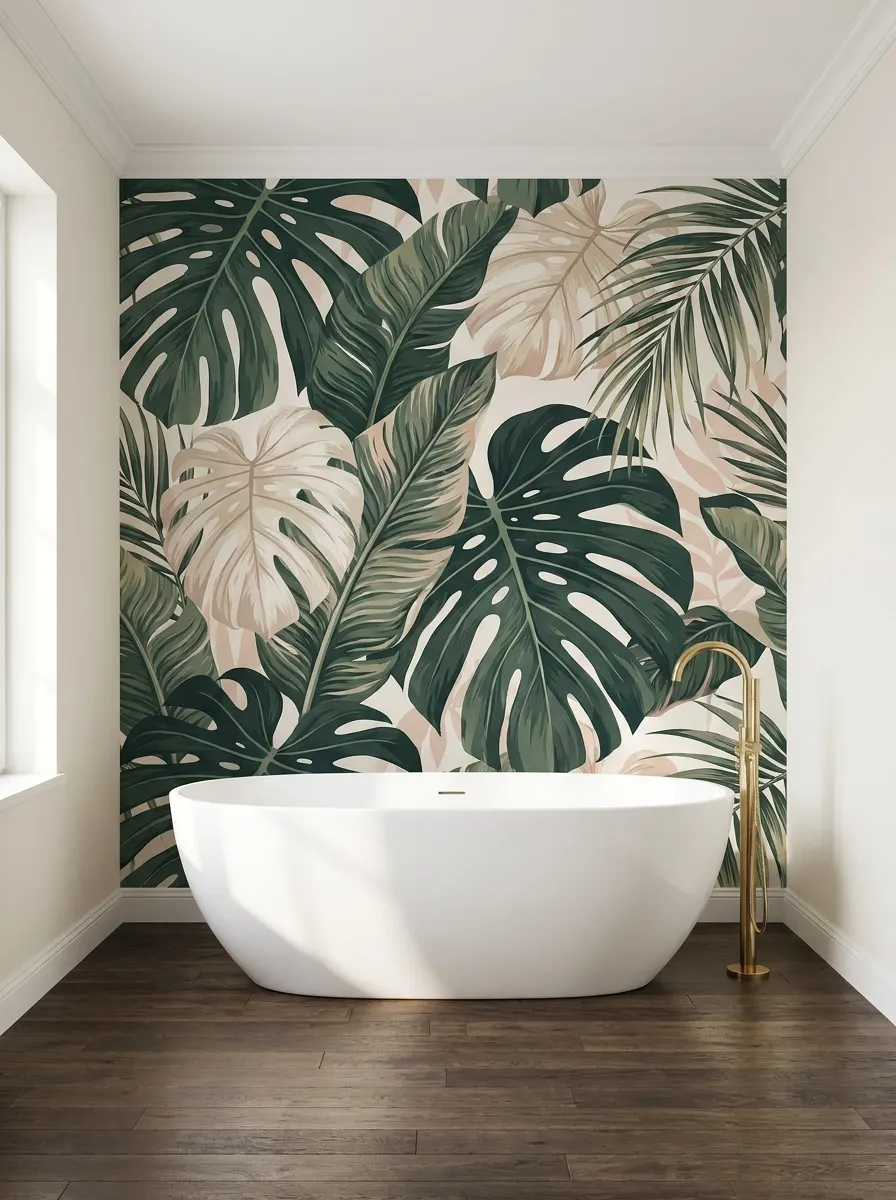
Botanical wallpaper does something that paint and tile cannot — it brings the full complexity of the natural world into a bathroom wall in one transformative application. A large-scale tropical leaf pattern in deep greens and warm creams creates an immersive quality that makes the bathroom feel genuinely transported — like stepping into a greenhouse or a tropical garden rather than a domestic washing space.
The single-wall application is the discipline that makes it work. A bathroom papered on all four walls in a large-scale botanical pattern feels enclosed and overwhelming for most people. One wall, fully committed, with three walls in warm white — this is the ratio that allows the pattern its full dramatic effect while keeping the room light, open, and liveable. The wall directly behind the bathtub is consistently the highest-impact placement.
The Key: One wall, fully papered, with three walls in clean warm white. That single-wall discipline allows a large-scale botanical pattern to be genuinely dramatic without making the bathroom feel smaller or more enclosed.
15
Muted Sage Paint White Trim
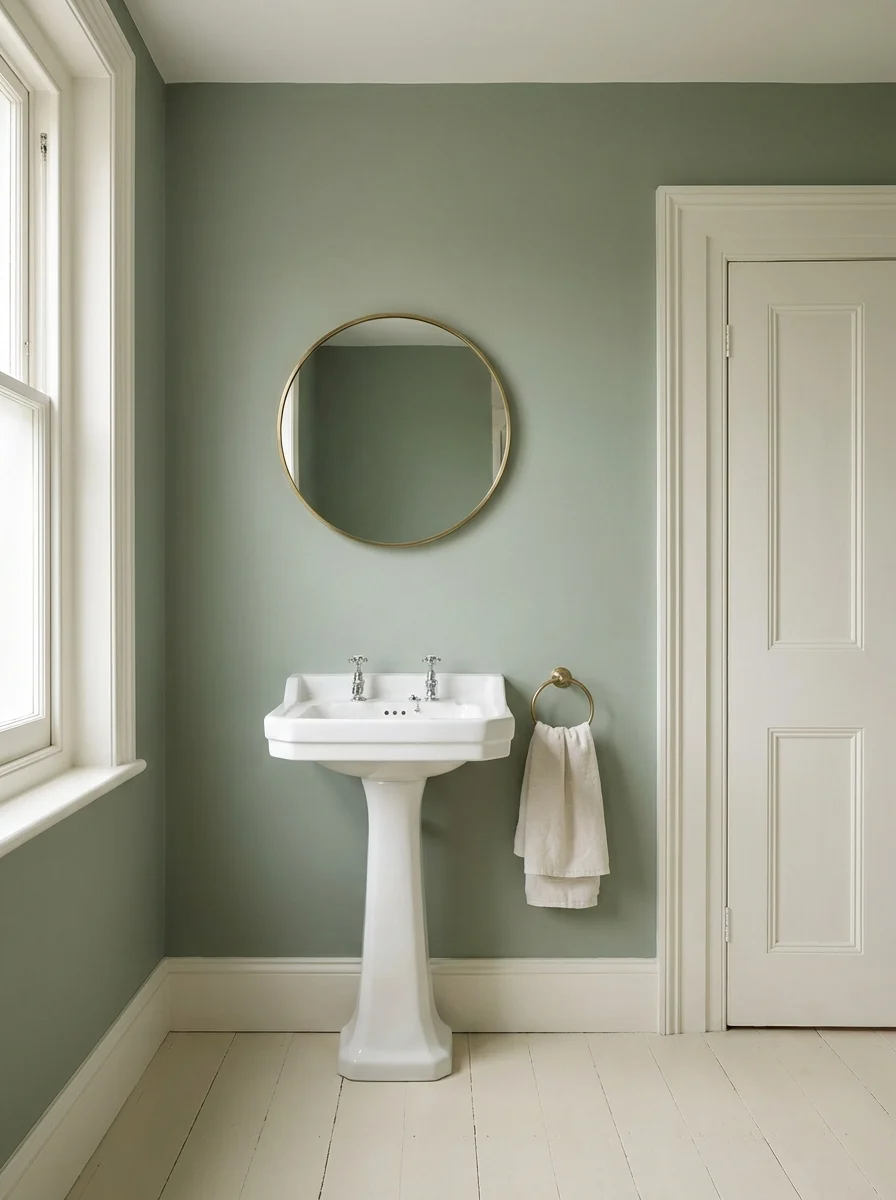
A full room in muted sage green with white trim is the most enduring green bathroom idea in this guide — the approach that will look considered and beautiful in ten years as clearly as it does today. The pairing of a muted, slightly greyed sage with clean white trim is as classically resolved as a design decision gets. The trim gives the room its architectural bones. The sage gives it warmth, color, and calm.
The saturation level is the critical decision. A saturated, vivid sage green on all four walls will feel overwhelming in most bathrooms. A muted, slightly greyed sage — the kind of color that could almost be mistaken for a very warm white in low light — is the tone that reads as sophisticated and spa-like rather than bold and fashion-forward. The bathrooms people consistently describe as calm and timeless are almost always in this specific register.
The Key: Muted is the operative word. A sage green that is slightly greyed, slightly quieted, clearly green but never loud — that is the tone that creates a bathroom you will never tire of, in any light condition or season.
16
Green Mosaic Shower Niche
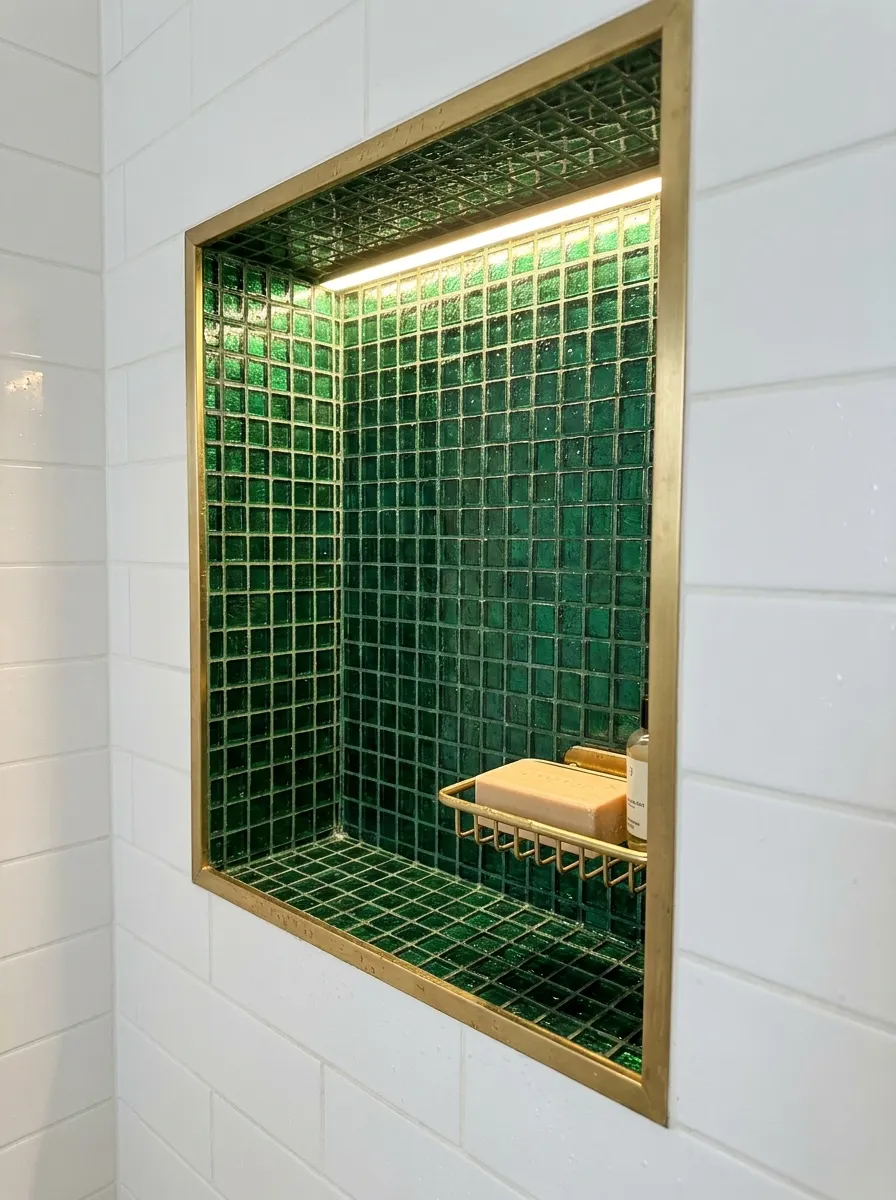
A shower niche is a small architectural moment that most people tile to match the surrounding shower walls and forget about. Tiling it differently — in a richly colored mosaic that contrasts with everything around it — transforms that small recess into the most detailed and surprising moment in the entire bathroom. A deep green glass mosaic niche inside a white subway-tiled shower reads like a jewel box: small, intensely colored, carefully framed, and genuinely unexpected.
The scale of mosaic is particularly effective in a niche because the small individual tiles create a richly textured surface that reads very differently from the large format tiles surrounding it. The texture catches the light from the shower and fractures it into small gleaming points — an effect that plain tile cannot achieve. A mosaic niche, once experienced in a real bathroom, becomes the detail that everyone immediately wants in their own shower.
The Key: Contrast is the point. A green mosaic niche inside a white shower works because of the dramatic difference between the two surfaces — remove the contrast by matching the niche to the surrounding tile and you remove the entire effect.
17
Green Natural Wood Vanity
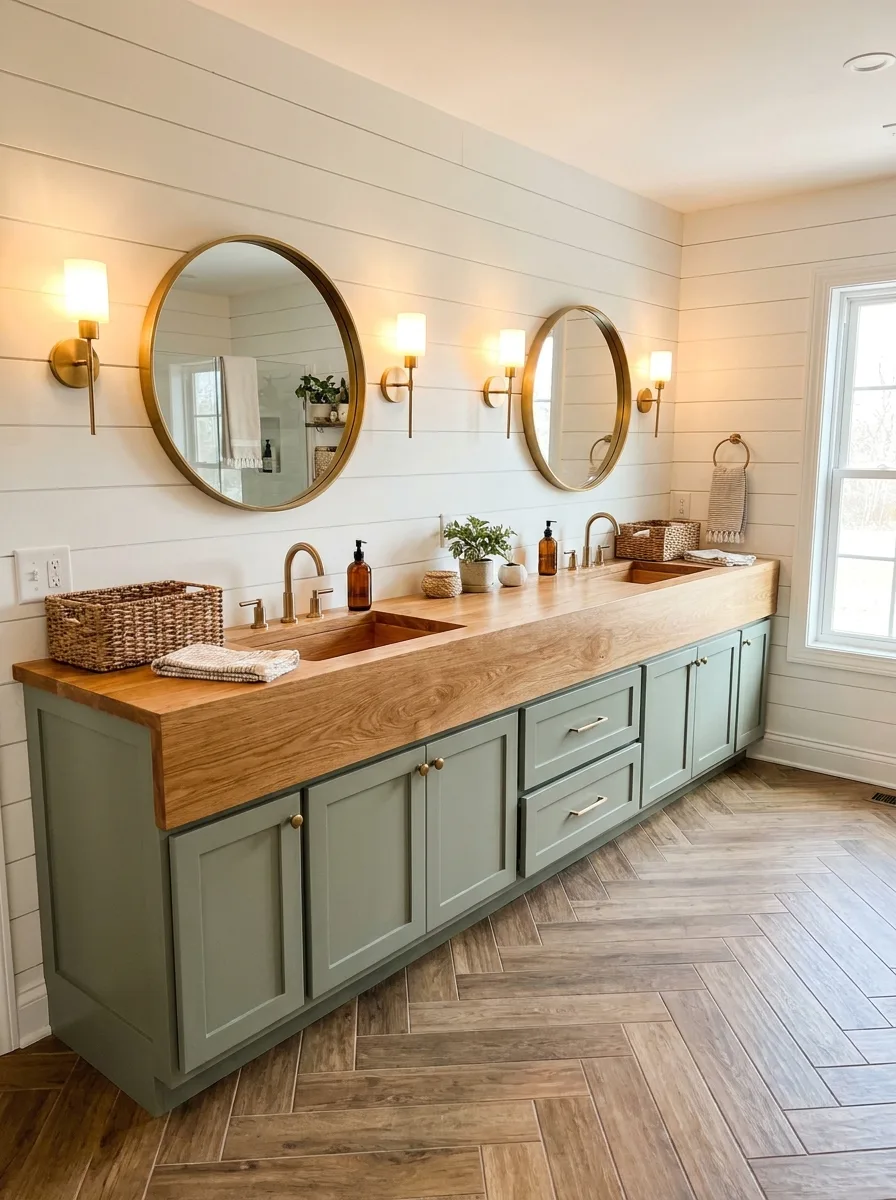
Green paint and natural wood is the material pairing that anchors the entire green bathroom aesthetic in something genuinely organic — it references the relationship between forest floor and tree canopy, between moss and bark, between the color of leaves and the material of branches. In a bathroom context, this translates to a sage green cabinet base beneath a warm oak or walnut countertop: two materials that look like they belong together.
The wood countertop is a commitment that requires ongoing care — annual sealing, careful drying after use — but delivers a warmth and tactile quality that no stone alternative matches. Running your hands along a warm, grained walnut countertop beside a sage green cabinet is a genuinely different sensory experience from a cold stone alternative. People who choose this combination consistently report a stronger emotional connection to their bathroom than those with more conventional material choices.
The Key: Green plus wood creates organic material harmony that references nature rather than merely referencing design. That connection to the natural world is why this pairing feels so immediately right and so consistently satisfying over time.
18
Vintage Green Mirror Frame
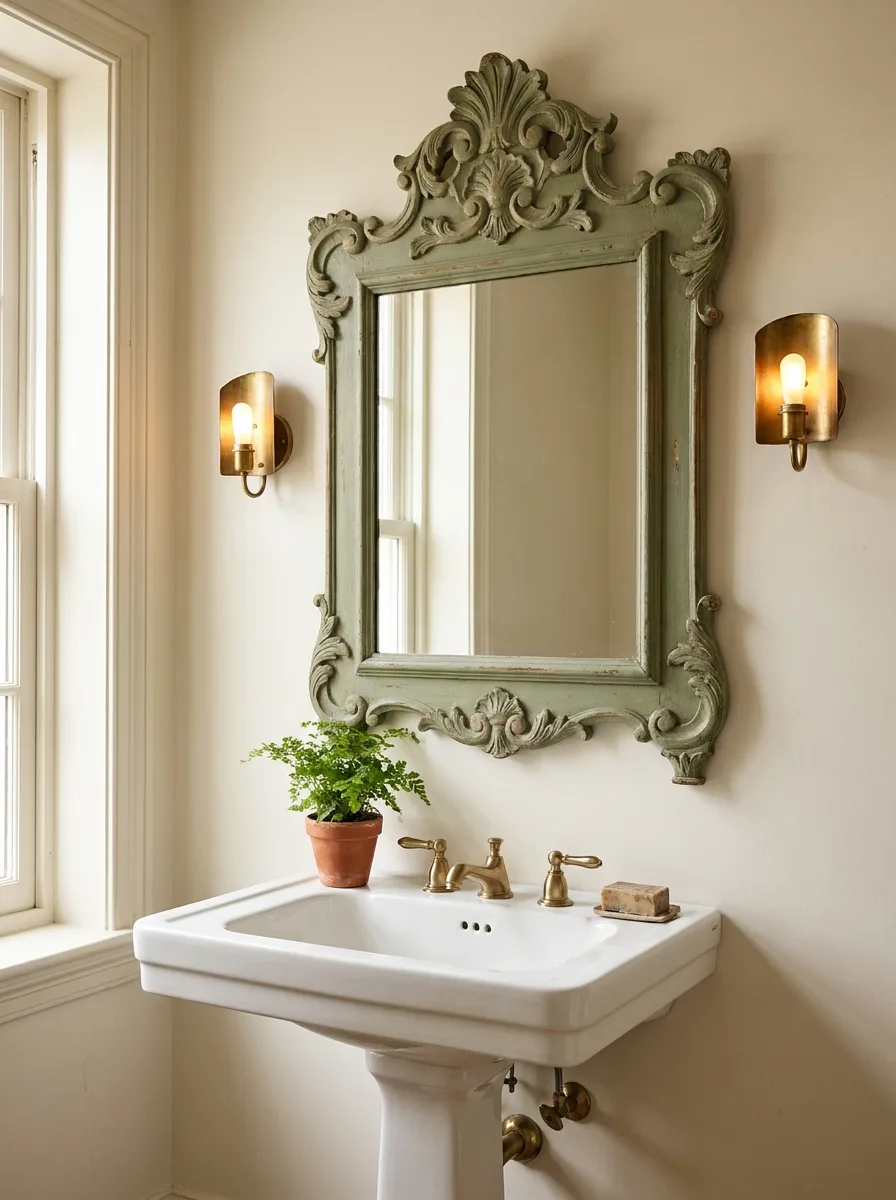
A vintage green mirror frame ties a green bathroom palette together at the most visually prominent level — eye height. In a bathroom where the green is predominantly at floor level in tile, or at vanity level in cabinet color, a green mirror frame lifts the color to the vertical centre of the room and creates a visual connection between the green below and the white above. It is a small object doing significant organizational work.
The character of the frame matters considerably. A flat, smoothly painted green frame looks like a design decision. An ornate, slightly distressed vintage frame in sage or olive green — the kind found at an antique market for very little money — looks like a discovery, like something the room has always had rather than something recently added. Vintage-framed mirrors in painted or aged green finishes are among the most consistently popular bathroom additions on Pinterest.
The Key: A green mirror frame connects the color palette at eye level — the visual center of the room. That connection is what makes a bathroom with multiple green elements feel cohesive rather than scattered.
19
Layered Green Tones Throughout
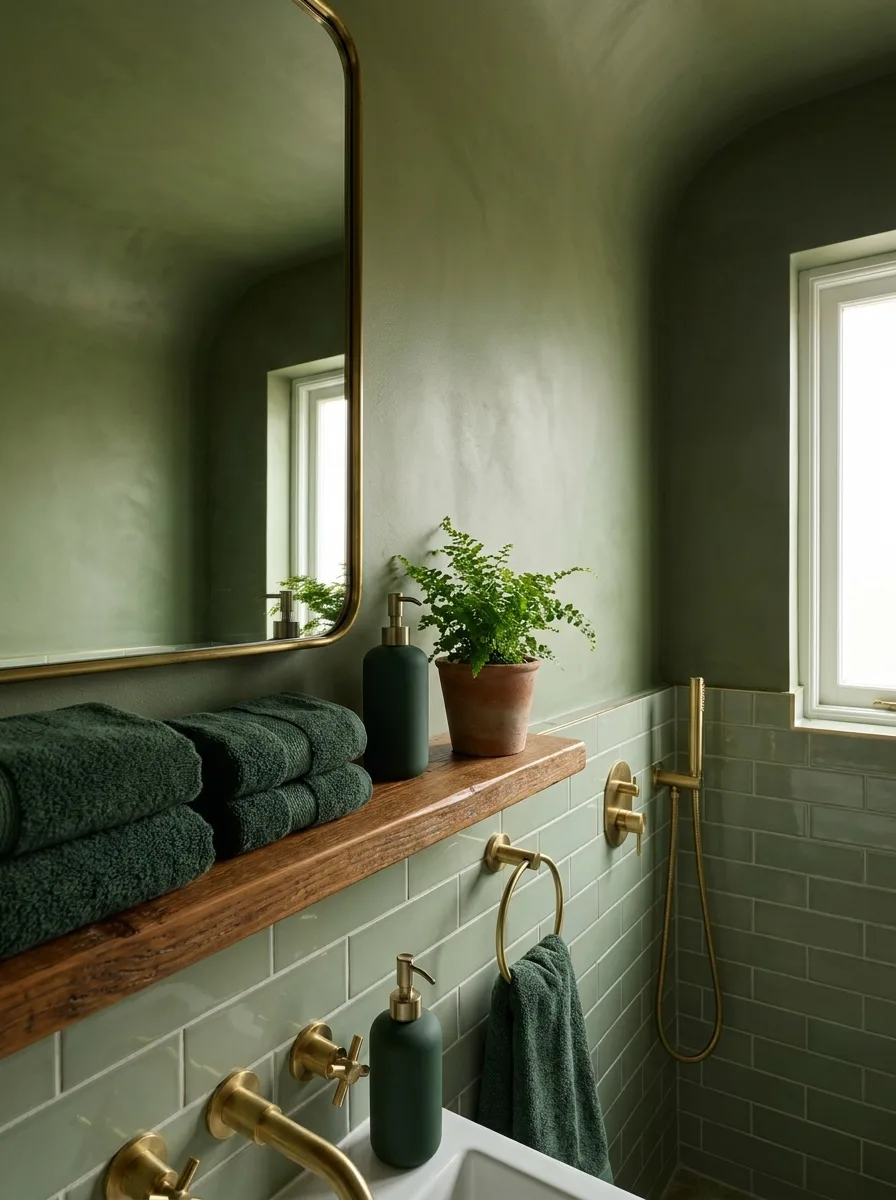
A bathroom that uses one green throughout can feel flat and slightly monotonous, because there is no variation for the eye to travel between. A bathroom that layers two or three related greens creates visual depth: something to notice at different scales, in different materials, at different distances. The lighter sage of the tile, the slightly deeper olive of the plaster above, the dark forest accent in the folded towel — together these create a room that rewards looking at from every angle.
The temperature discipline is the rule that makes layered greens work rather than clash. Warm greens — those with yellow or earthy undertones — must stay within the warm family throughout. Cool greens — those with blue or grey undertones — must stay within the cool family. Mixing a warm sage tile with a cool blue-green paint above it creates a visual tension that most people register as something being wrong without immediately knowing what.
The Key: Same temperature family, lighter to deeper from ceiling to floor. That discipline makes layered greens feel intentional and unified rather than mismatched and accidental.
20
Wicker Natural Basket Accessories
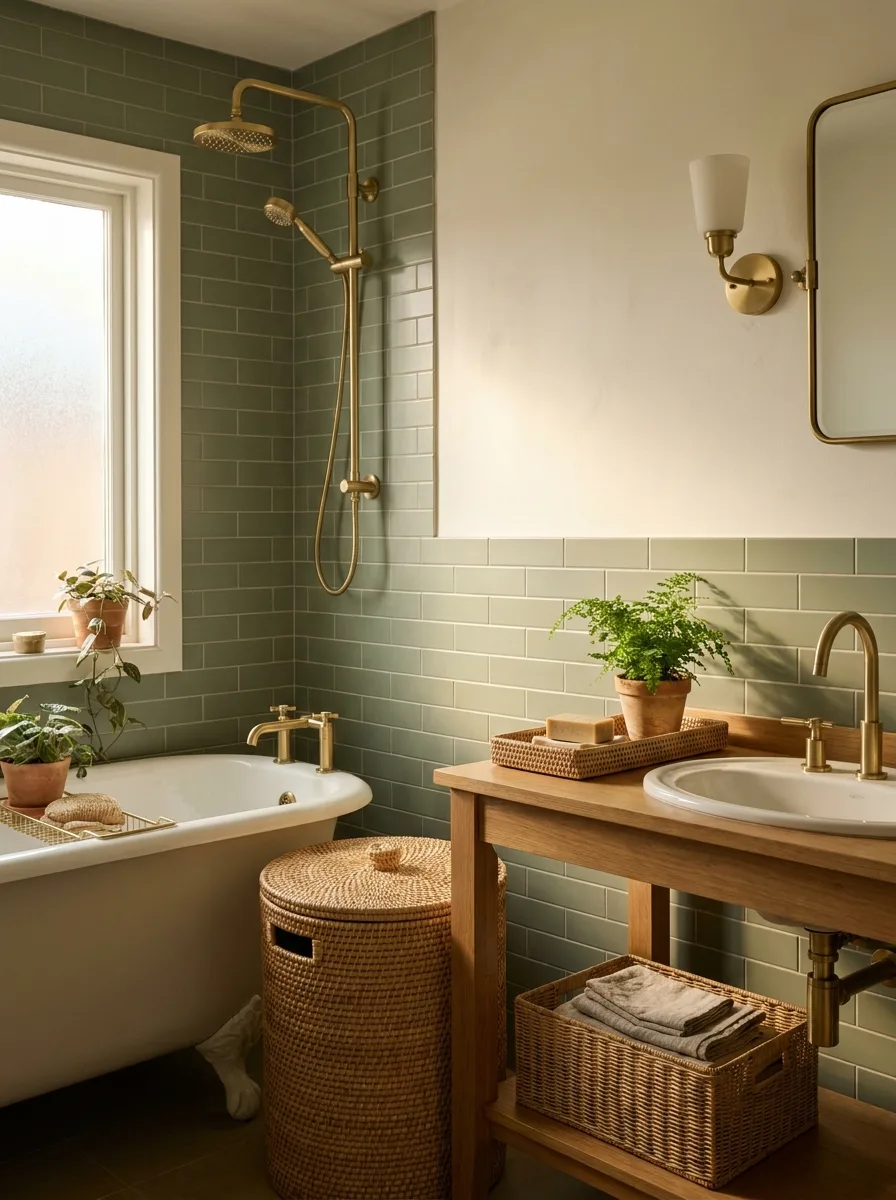
Wicker and natural woven accessories belong in a green bathroom in the same way they belong in a garden room — they speak the same material language as the color, reinforcing the organic, botanical world that green evokes. A wicker laundry basket beside sage green tiles, a rattan tray on a warm wood shelf, a woven seagrass bin beneath the vanity — these elements together create a bathroom that feels genuinely immersed in natural materials.
The practical dimension matters in a bathroom where every accessory earns its visual place more directly than in other rooms. A wicker laundry basket that is both beautiful and functional is a better choice than a decorative object that adds visual warmth but serves no other purpose. Every natural material object in a green bathroom should do something useful while also being genuinely lovely to look at — the principle that makes bathrooms feel effortlessly coherent.
The Key: Natural woven materials reinforce the green bathroom’s botanical palette at the level of texture and material honesty. Choose wicker and rattan for functional storage pieces and every accessory earns its place doubly — practically and visually.
A green bathroom is not a trend to chase — it is a design decision to make with confidence and keep forever. The right shade of green, in the right material, in the right quantity for your space, creates a bathroom that grows more beautiful and more personal with every year you spend in it.
Every idea in this guide is designed to help you find that right combination — whether your green is a single eucalyptus bundle hung from the shower head or a full suite of forest green cabinetry with mosaic tile and brass hardware. Start with one idea this weekend. Build from there. The green bathroom that feels exactly like yours is only a few considered decisions away.
Save this to your Pinterest board and share it with anyone who has ever stood in a white bathroom and wondered if it was missing something — because it was, and now you both know what.