Italian Tuscan kitchen
🏠 24 Real Ideas
⏱ Quick Read
🔥 Always Trending
24 How to Steal the Secret Sauce of Italian Tuscan Kitchen Ideas
That Bring Old-World Charm to Modern Homes
There is a specific kind of warmth that a Tuscan kitchen carries — something between a farmhouse in the Chianti hills and a trattoria that has been feeding the same village for three generations. It is not a look that was designed. It evolved over centuries of cooking, gathering, and building beautiful things from honest materials. And the extraordinary thing is that you can bring it home, regardless of where home actually is.
These 24 Italian Tuscan kitchen ideas draw directly from that tradition — exposed beams, terracotta tiles, hand-painted ceramics, copper pots, aged stone, and the kind of generous abundance that says someone in this kitchen loves to cook and loves to feed people. Even small doses of these elements — one open shelf of Italian ceramics, one farmhouse sink beneath a sunny window — can shift an entire kitchen toward something that feels genuinely warm, crafted, and alive. Let’s get into it.
01
Exposed Wooden Ceiling Beams
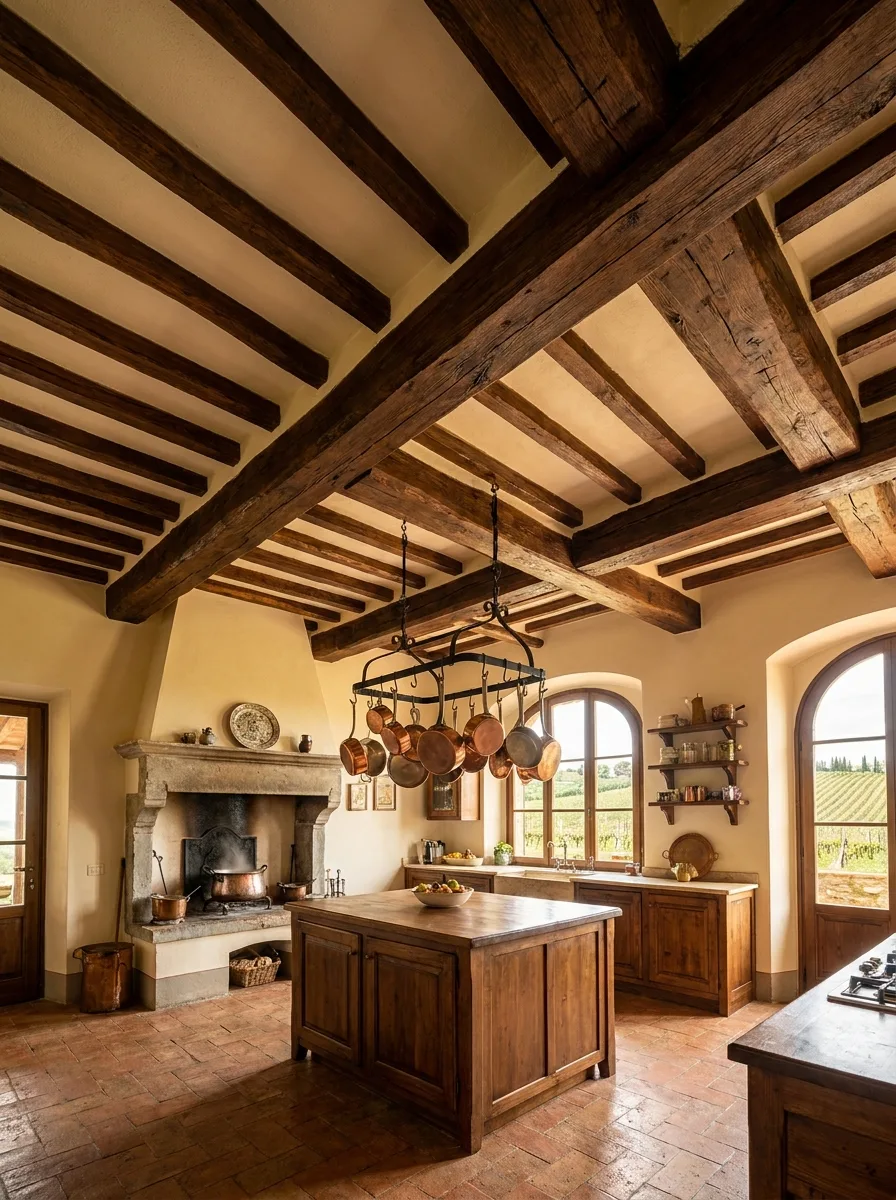
Nothing establishes the identity of an Italian Tuscan kitchen faster or more completely than exposed wooden ceiling beams. They are the first thing the eye travels to when entering the room, and they set an expectation of warmth, craftsmanship, and old-world authenticity that every other element then works to fulfill.
The character of the wood matters enormously. A smooth, perfectly milled beam reads as modern and manufactured. A hand-hewn beam with irregular texture, visible adze marks, and natural color variation reads as genuinely old — carrying centuries of history in its grain. Rough versus smooth is the single biggest determinant of whether a beam looks authentic or merely decorative.
The Key: Rough, textured, darkly toned beams read as genuinely Tuscan. Smooth, uniform, light-toned beams read as imitation. The character of the wood is the character of the kitchen.
02
Terracotta Floor Tiles
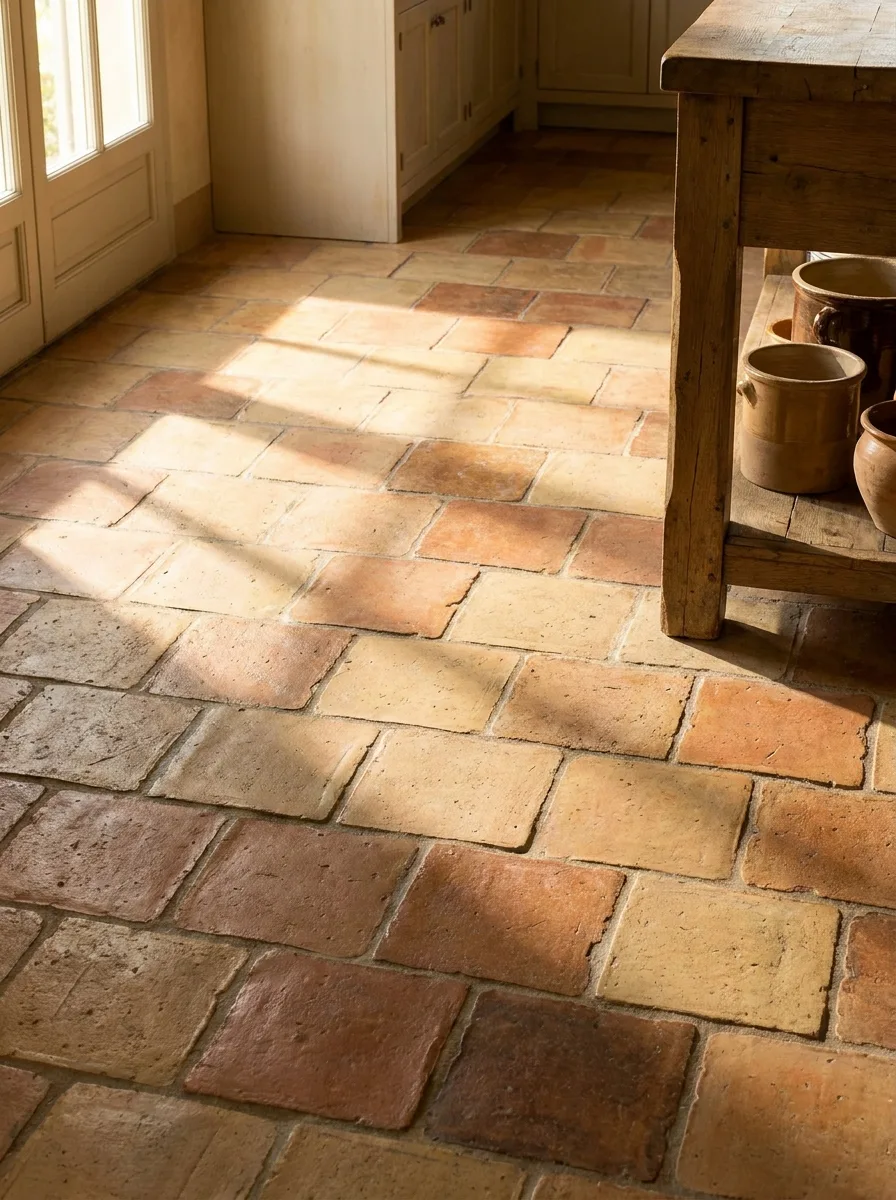
Terracotta is Italian for baked earth, and that etymology tells you everything about why these tiles belong in a Tuscan kitchen. Made from the red clay soil of the Italian countryside, walking on terracotta in a Tuscan-style kitchen is, in a small but genuine way, walking on Italian soil.
The imperfections are the point. Machine-cut, factory-uniform tiles might achieve a similar color, but they lack the irregular edges, tonal variation, and surface texture that makes genuine terracotta feel like it belongs in a centuries-old farmhouse. Overly perfect floor tiles break the illusion of age and craft that everything else is working to create.
The Key: Embrace the imperfection. Tonal variation, irregular edges, and natural surface texture are not flaws — they are the qualities that make terracotta authentic, warm, and genuinely Tuscan.
03
Warm Cream Plaster Walls
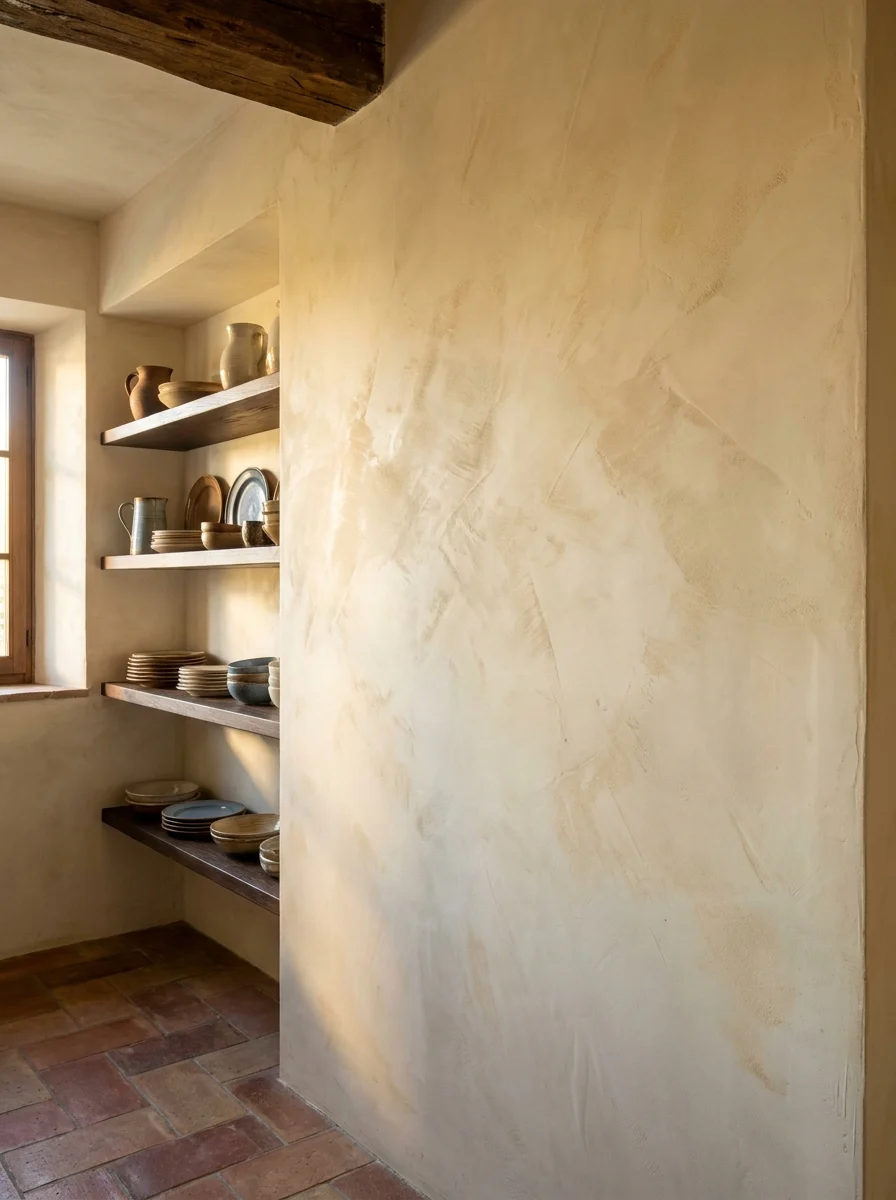
The walls of an Italian Tuscan kitchen are not simply a backdrop — they are an active, textured, warm presence. The lime plaster walls of real Tuscan farmhouses have been built up in layers over centuries, and their texture and warmth come from that accumulated history of craft. Replicating this means achieving honest, handcrafted texture in a warm neutral tone.
Venetian plaster applied by hand with a steel trowel achieves this beautifully. The burnishing creates a surface with depth — slight variation in sheen, subtle tonal movement, and a warmth that responds to natural light in a way painted drywall simply cannot. This wall treatment alone, before a single decorative element is introduced, transforms a kitchen into something rooted in old-world tradition.
The Key: The wall texture in a Tuscan kitchen is as important as its color. A warm cream in flat paint is a starting point. The same color in Venetian plaster or limewash is a Tuscan kitchen wall.
04
Open Wooden Shelving Ceramics
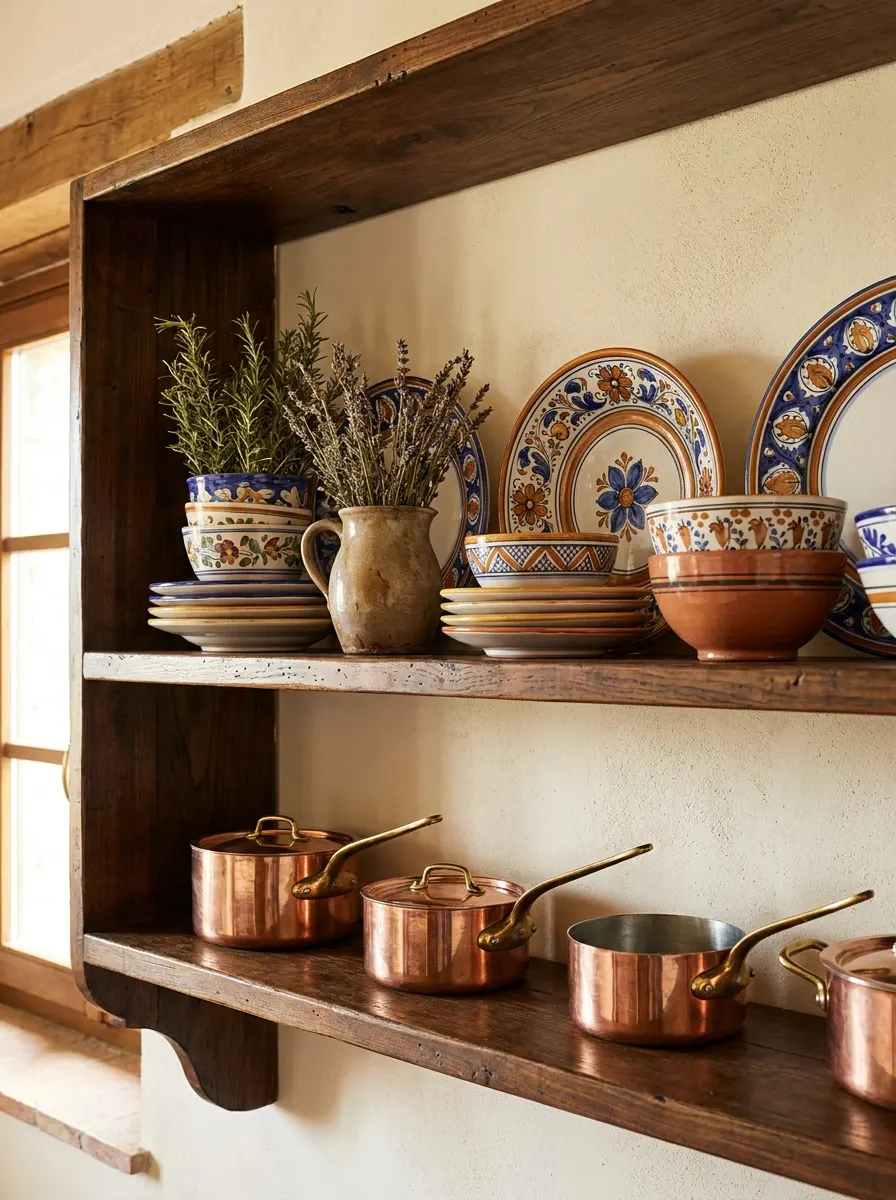
Open shelving in a Tuscan kitchen does something that closed cabinets cannot — it makes the room feel inhabited by people who cook, collect, and care about beautiful objects. The Italian kitchen has always been a place where the tools and vessels of cooking are displayed with pride rather than hidden behind cabinet doors.
The ceramics are the stars. Italian hand-painted pottery — the cobalt blue and warm yellow patterns of Deruta, or the richly colored Vietri pieces — brings color, pattern, and artisanal quality into a Tuscan kitchen unlike any other element. Even a small collection of six to eight genuine hand-painted pieces on simple wooden shelves can transform an entire kitchen into something authentically Italian.
The Key: Let the ceramics tell the story. Open shelves are the stage, but the hand-painted pottery is the performance — choose pieces that are genuinely beautiful and display them with generous, abundant confidence.
05
Farmhouse Ceramic Sink
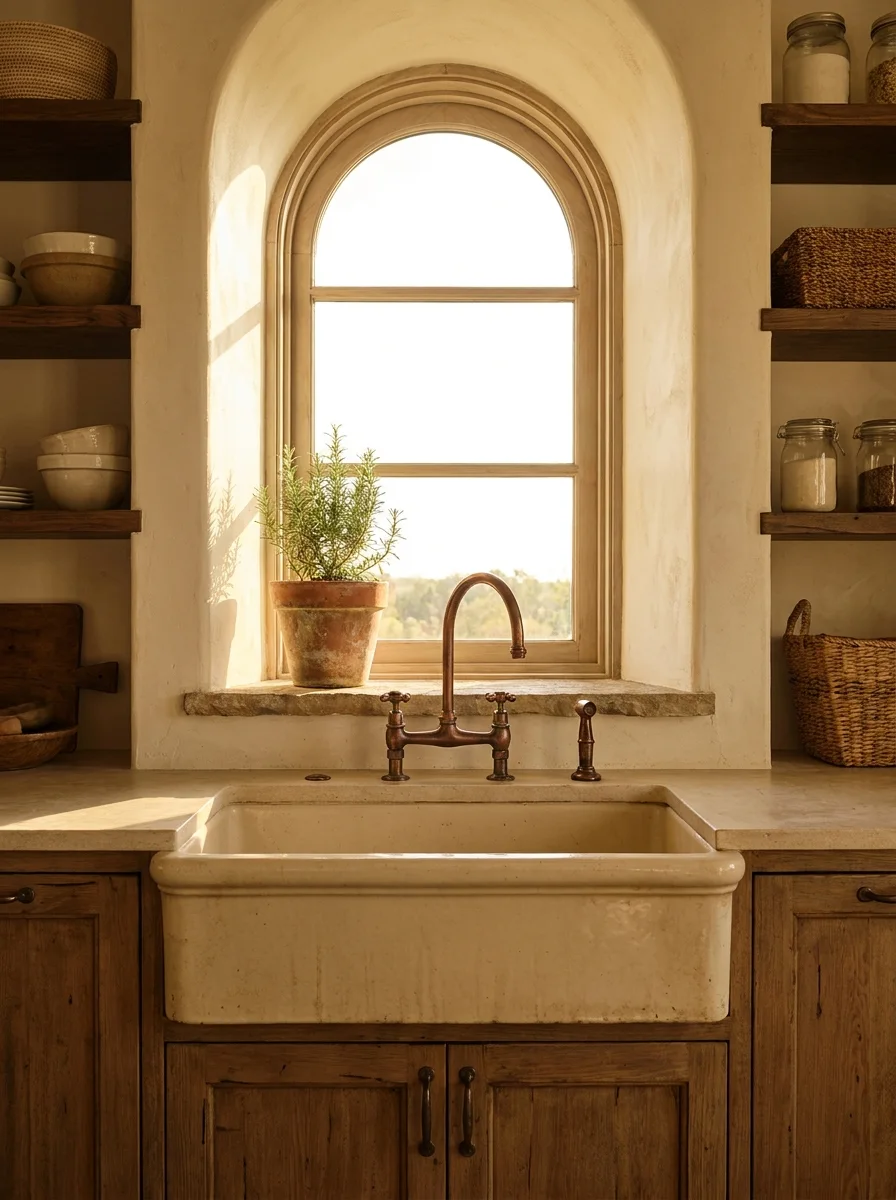
The farmhouse sink is simultaneously deeply practical and deeply beautiful — a combination Italian design has always valued over form or function alone. Sized generously for large pots and baking dishes, it sits beneath the window with a quiet authority that no undermount or drop-in sink can match. It looks like it has always been there.
The aging of the ceramic matters for authenticity. A crisp, bright white apron-front sink looks modern and sanitized — qualities at odds with the worn, sun-warmed character of a Tuscan kitchen. Aged white or warm ivory ceramic, particularly one that develops slight crazing in the glaze over time, looks like it was installed in a Florentine farmhouse a century ago.
The Key: Material aging is what makes a farmhouse sink feel Tuscan. Warm ivory over bright white, copper over chrome, visible patina over clinical perfection — these distinctions make the difference.
06
Copper Pots Hanging Rack
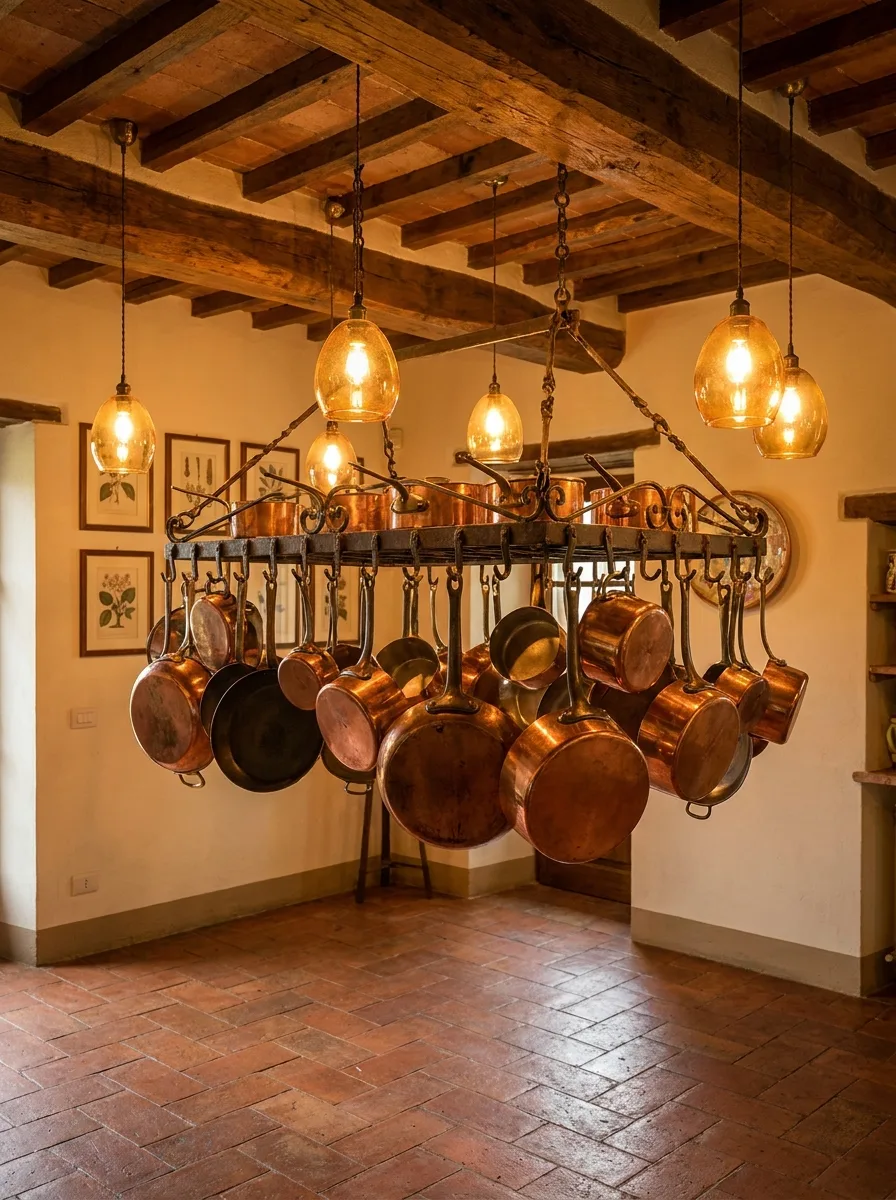
Copper cookware hanging from a wrought iron rack is the most immediately recognizable visual signature of an Italian Tuscan kitchen — and it earns that status because it is genuinely functional. Italian cooks have used copper pots for centuries because copper conducts heat better than almost any other material. The hanging rack keeps pots accessible and displayed simultaneously.
The patina of copper is one of its greatest assets. New copper is bright and brassy — attractive but slightly jarring in a room meant to feel aged and collected. Used copper, darkened by heat and handling, has a warmth and depth that reads as genuinely authentic. A set of well-used copper pots on a wrought iron rack does more to establish Tuscan character than almost any other single element.
The Key: Copper earns its place in a Tuscan kitchen twice — functionally as superior cookware and visually as the warmest, richest metal accent available. Display it generously and let it develop its patina naturally.
07
Stone or Marble Countertops
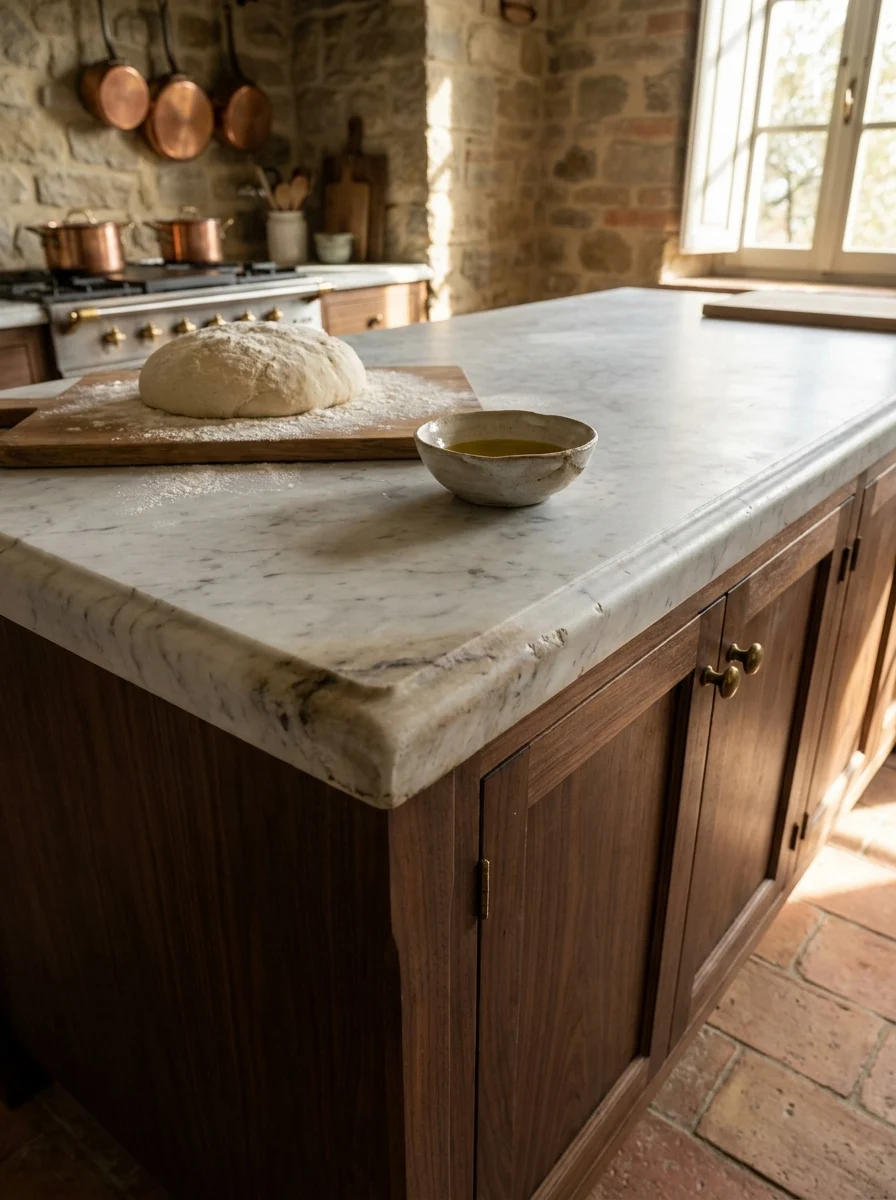
Stone countertops in a Tuscan kitchen are surfaces meant to be used. Unlike pristine, protected quartz, a honed marble or aged limestone surface develops its character through cooking — olive oil soaking in slightly, flour settling into the texture during bread making, marks left by decades of daily use. These are not damage. They are evidence of a kitchen that has fed people.
Honed over polished is a significant distinction. A polished marble surface reflects light sharply and reads as contemporary. A honed surface absorbs light softly, shows its natural veining honestly, and develops the gentle patina of use that makes a Tuscan counter look authentically old. This single finish decision — honed instead of polished — can make the difference between marble that feels Italian and marble that feels like a luxury renovation.
The Key: Choose honed over polished, thick over thin, and natural imperfection over engineered perfection. A Tuscan kitchen countertop should look like it has been the center of serious cooking for a very long time.
08
Wrought Iron Hardware Fixtures
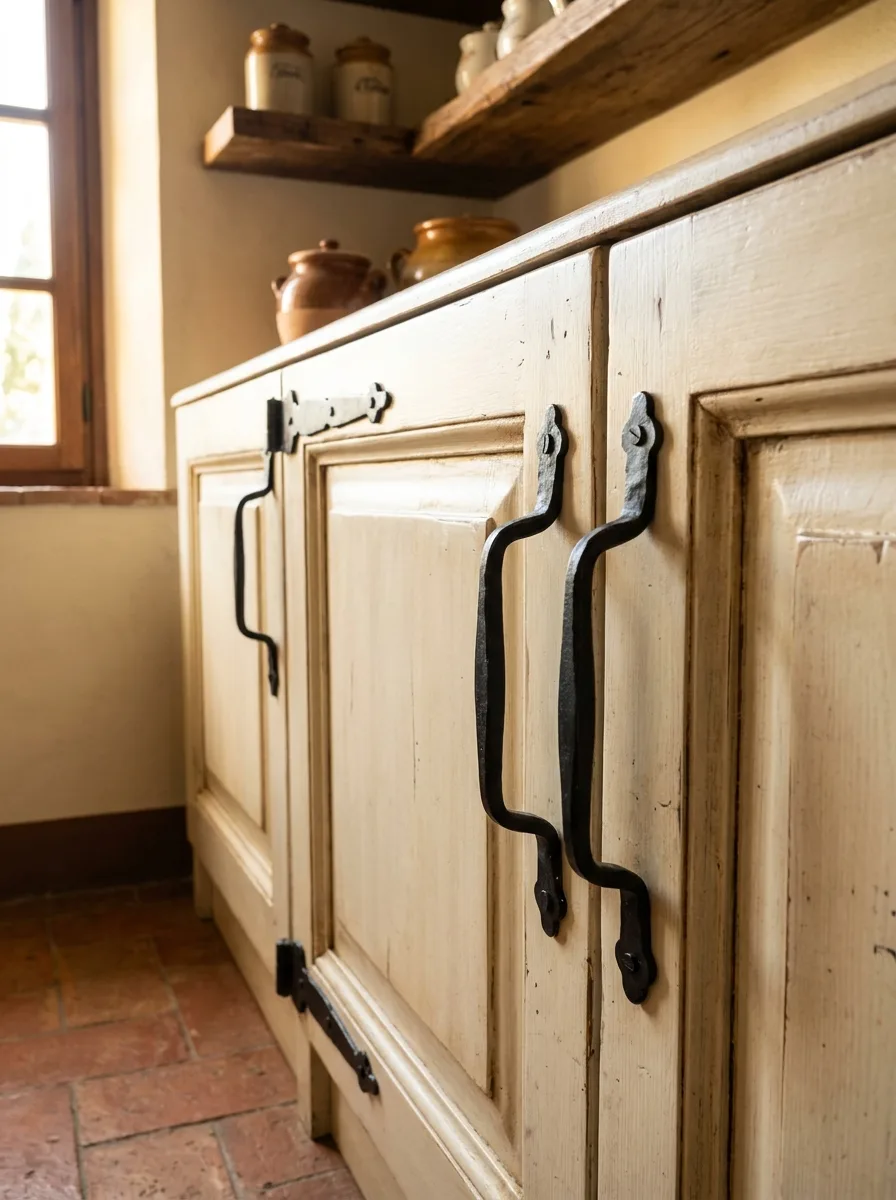
Hardware is the jewellery of a kitchen — small in scale but significant in cumulative effect. In a Tuscan kitchen, where every material choice makes a statement about craft and authenticity, hardware cannot be an afterthought. Polished chrome pulls on a cabinet trying to evoke a centuries-old Italian farmhouse is a contradiction the eye registers immediately as wrong.
Wrought iron — or its modern equivalent, hand-forged cast iron hardware in matte black — resolves that contradiction cleanly. It belongs to the same material family as the hanging pot rack and the window grilles of old Tuscan buildings. Installing it throughout a kitchen immediately establishes material coherence. Replacing cabinet hardware is one of the fastest and most affordable ways to shift a kitchen toward authentic Tuscan character.
The Key: Hardware coherence is non-negotiable. Choose wrought iron or oil-rubbed black for every pull, hinge, and fixture, and the kitchen’s material story becomes cohesive. Mix finishes and it fractures immediately.
09
Arched Doorways and Niches
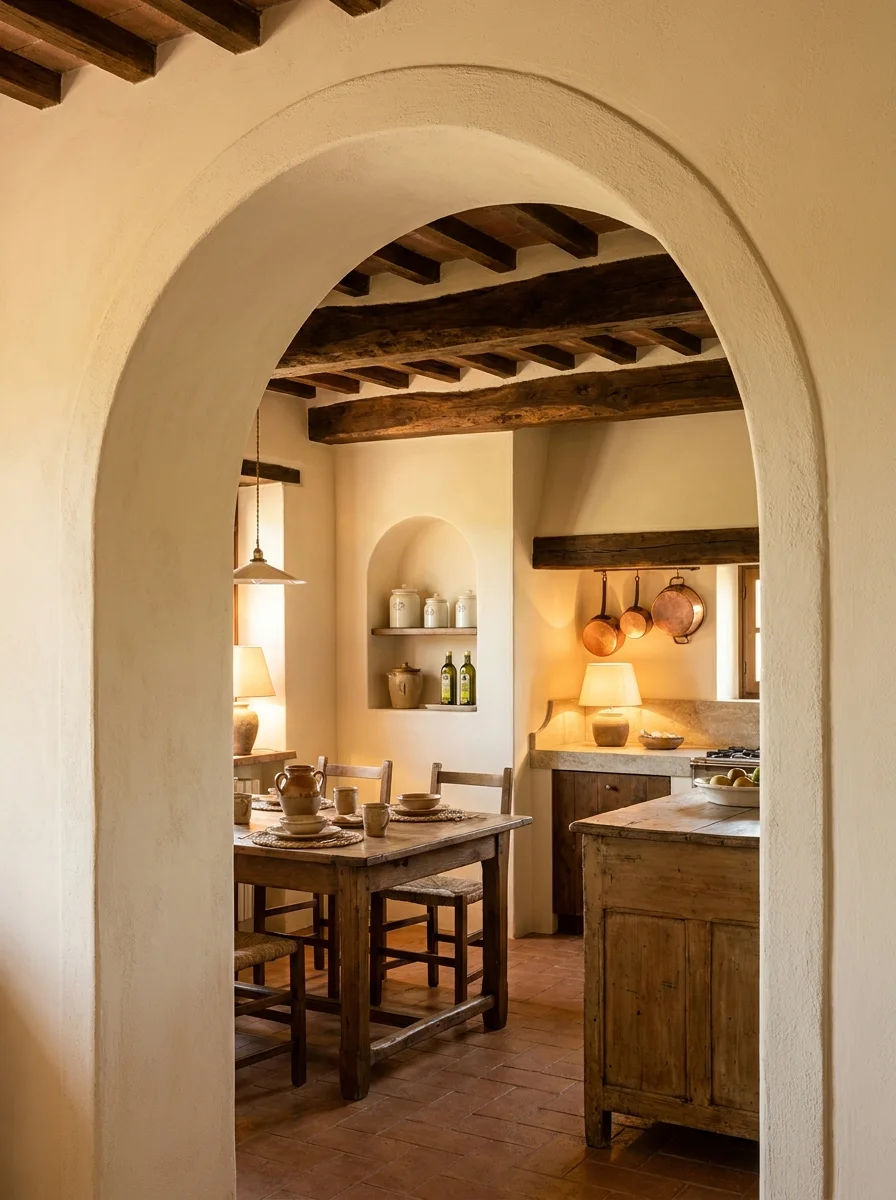
The arch is one of the oldest and most enduring forms in Italian architecture — from Roman aqueducts to Renaissance doorways to the simple openings between rooms in a Tuscan farmhouse. In a kitchen, a simple plastered arch over a doorway immediately elevates the space from a room with a door hole to a room with an architectural moment.
Adding an arch to an existing square doorway is more achievable than most people expect. A curved wooden form, finished with wire mesh and plaster, can transform a standard door opening in a single weekend. The result — a rounded, plastered arch with slightly thickened edges in warm cream — looks like it was part of the original building.
The Key: The arch does the work of a renovation for a fraction of the cost. One arched doorway or niche introduces an architectural vocabulary that speaks Italian farmhouse immediately and reframes every other element around it.
10
Rustic Wooden Kitchen Island
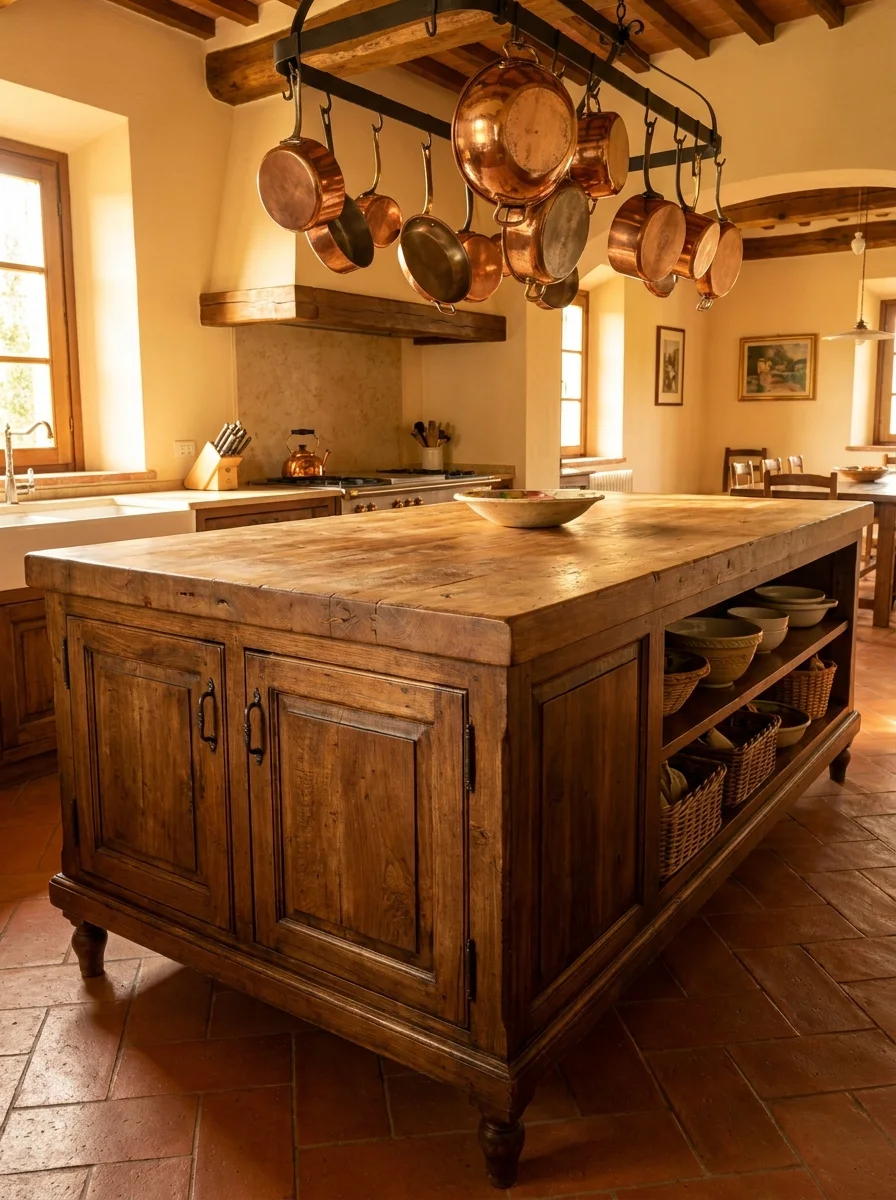
The kitchen island in a Tuscan farmhouse kitchen is not a sleek, built-in architectural feature — it is a piece of furniture that happens to live in the kitchen. A furniture-like island, with visible legs or paneled sides and a thick wood top, communicates the same honest craftsmanship that defines every other element of the Tuscan aesthetic. It looks like it could be moved, like it belongs rather than being installed.
The butcher block surface is a key element. It accepts the marks of use — knife scores, heat rings, the slight darkening from olive oil and vegetable juices — in a way that transforms daily cooking into material aging. A well-used butcher block surface is one of the most photographed details in a Tuscan kitchen, because it communicates clearly that this is a kitchen where real food is made by real people who love to cook.
The Key: Make the island look like furniture, not cabinetry. Visible legs, a thick natural wood top, and wrought iron hardware give it the freestanding, furniture-like quality that is the hallmark of a genuine Tuscan kitchen.
11
Hand-Painted Tile Backsplash
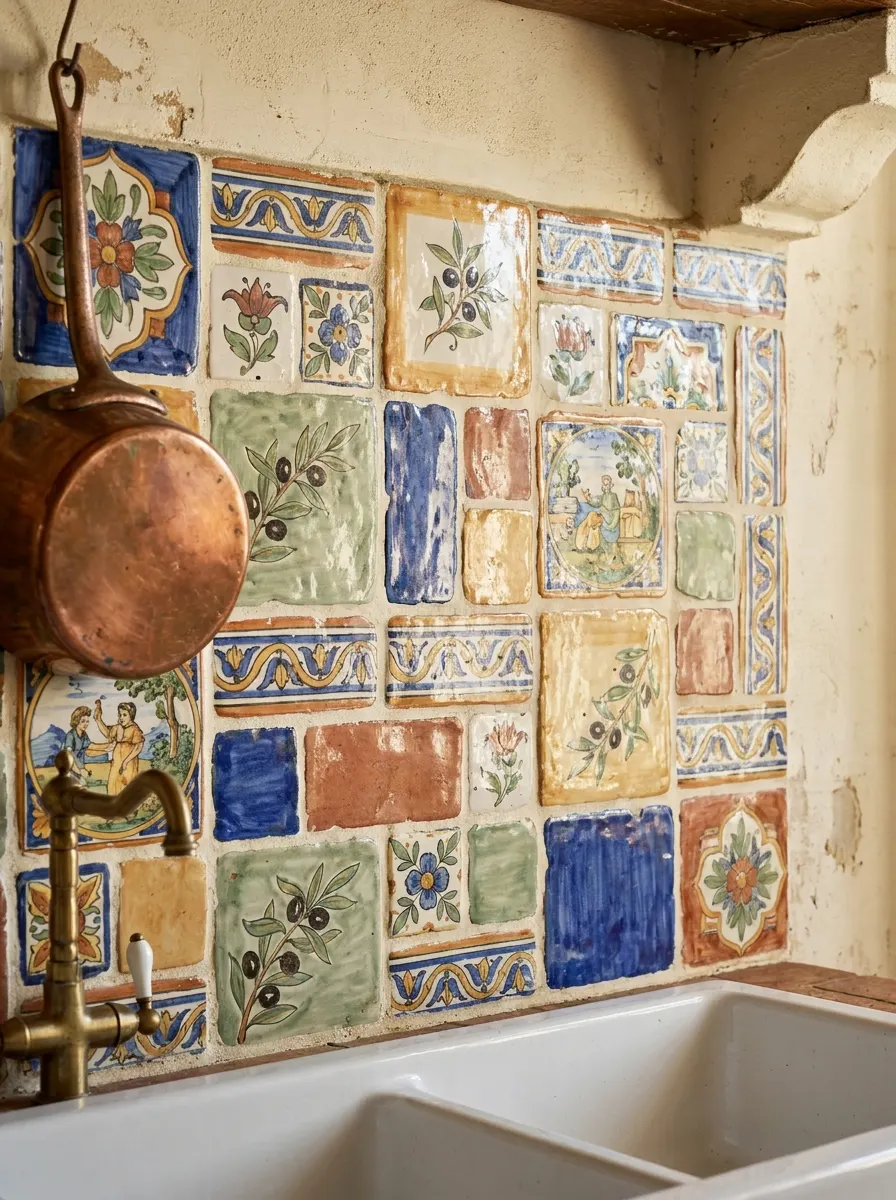
A hand-painted tile backsplash is the most colorful and joyful element of a Tuscan kitchen — where the room’s warm material palette gives way to something more expressive. Italian ceramic painting traditions, particularly those of Deruta in Umbria and Vietri Sul Mare in Campania, have produced some of the world’s most beautiful decorative tile work.
The authentic approach is not to match everything perfectly — it is to mix patterns within a cohesive color family and let the result look genuinely collected. A border tile of geometric repeats alongside a field tile of hand-painted florals, all within the same cobalt, ochre, and terracotta family, looks like tiles sourced from different artisans over time — which in a real Tuscan kitchen, they would have been.
The Key: Mix patterns freely within a cohesive color family. A Tuscan backsplash that looks collected and slightly eclectic always looks more authentic than one that looks perfectly coordinated from a single source.
12
Vintage or Rustic Chandelier
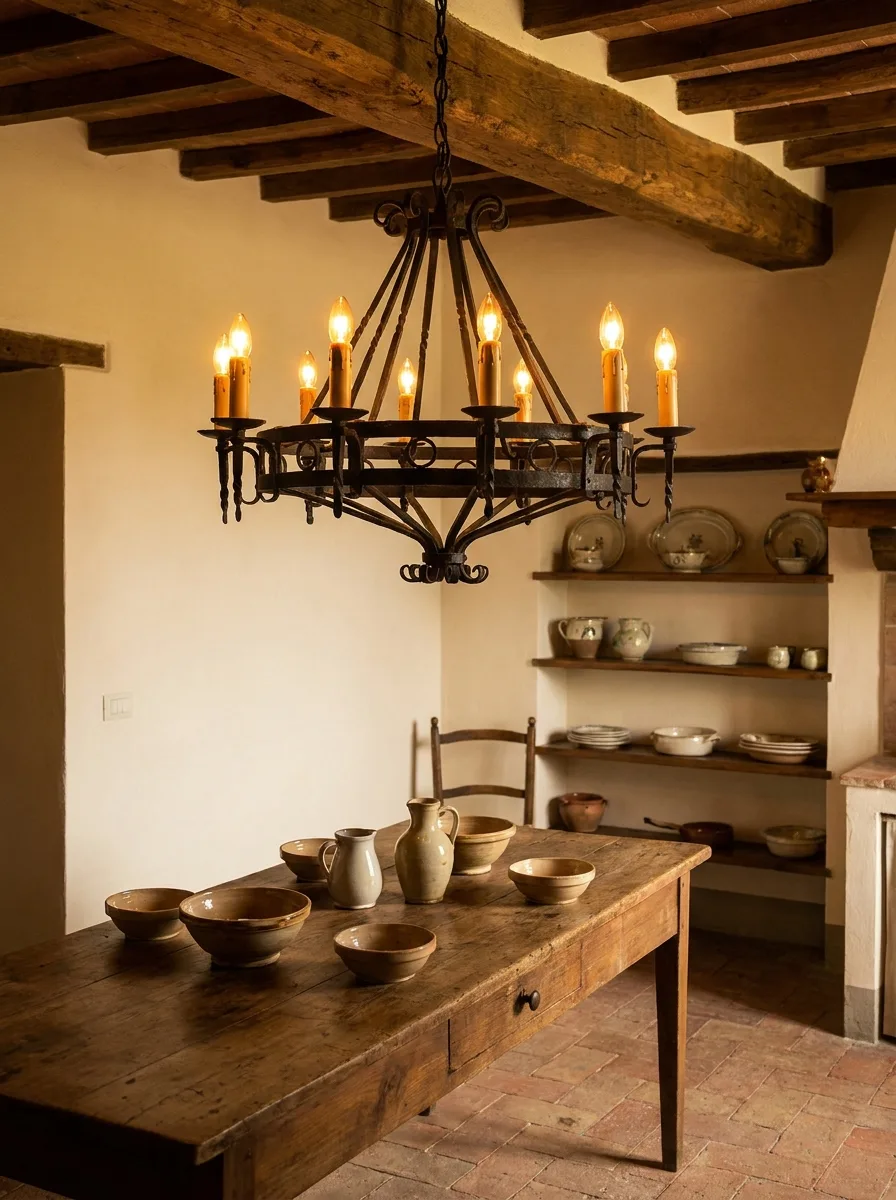
Lighting in a Tuscan kitchen is dramatic in the evening and warm throughout the day — and the chandelier bridges those two qualities. A wrought iron chandelier with candle-style bulbs, hanging above the kitchen table or island, casts warm, slightly directional light that creates the same effect as candlelight at scale. It illuminates copper pots and catches the glaze on hand-painted ceramics.
The hanging position matters as much as the fixture itself. A chandelier suspended from a ceiling medallion on flat drywall looks like a light fixture in a kitchen. A chandelier hung directly from a dark wooden beam on an iron hook looks like it has been there for a hundred years and belongs completely. This single detail — from beam rather than ceiling — is often the difference between a Tuscan kitchen that photographs like a magazine and one that photographs like a renovation.
The Key: Hang from the beam, not the ceiling. That positional decision places the chandelier within the architectural language of the room rather than above it, and makes the entire composition feel genuinely historic.
13
Herb Garden Windowsill
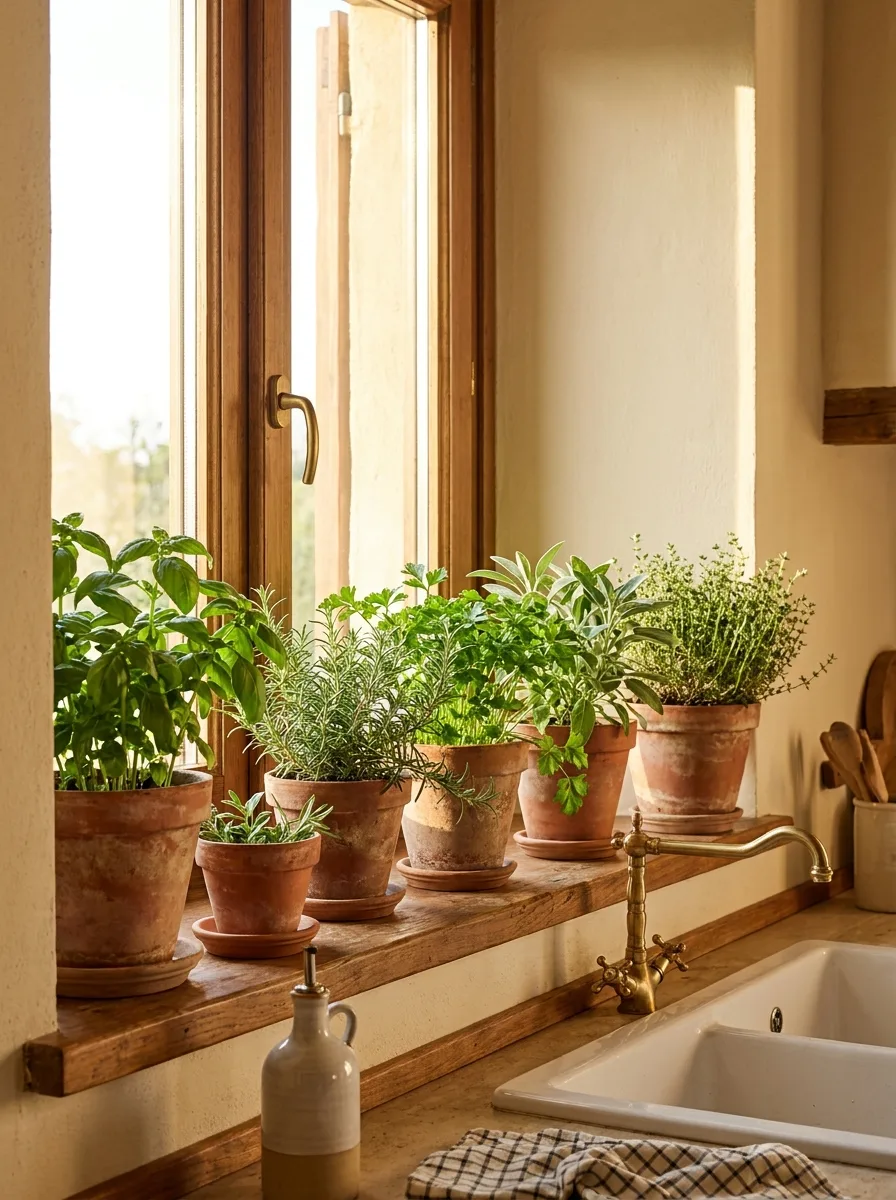
A kitchen windowsill herb garden is where the Tuscan kitchen’s aesthetic and culinary purpose merge completely. In a real Tuscan farmhouse, the herbs on the windowsill are not there to look beautiful — they are there because the cook reaches for them daily, pinching basil for a sauce, stripping rosemary for a roast. The beauty is entirely incidental to the function, which is exactly why it is so authentic.
Terracotta pots are non-negotiable. Plastic or glazed ceramic containers introduce a material that does not belong to the Tuscan kitchen palette. A simple unglazed terracotta pot — slightly dusty, slightly weathered at the rim — looks like it was bought at a village market in Siena for a few euros. This one detail is the most instantly recognizable and most emotionally evocative element of the entire Tuscan kitchen aesthetic.
The Key: Use the herbs. A well-used herb garden — slightly picked over, actively growing, sending fragrance into the kitchen — looks and feels more Italian than a perfectly trimmed decorative arrangement. Cook from it daily.
14
Wooden Wine Rack Detail
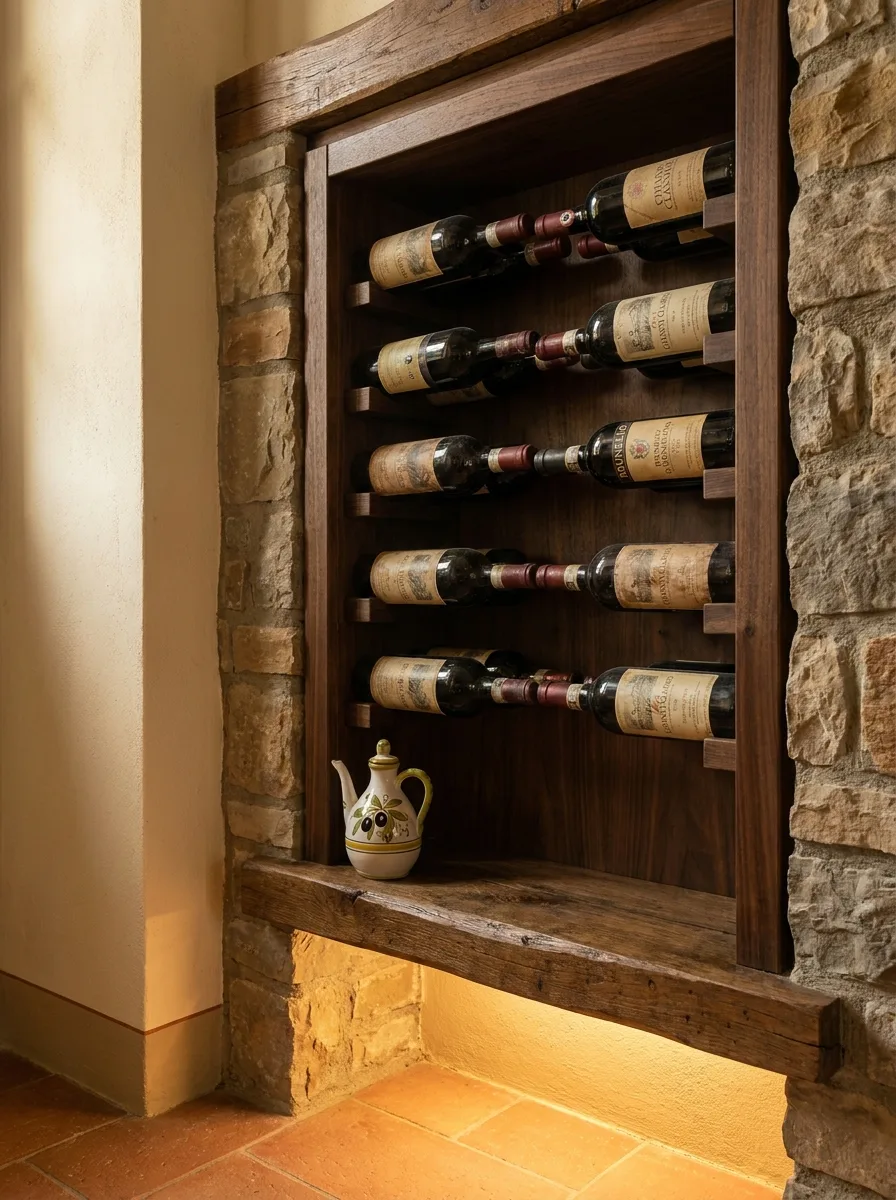
In an Italian kitchen, wine is not stored in a separate cellar and brought out for special occasions. It is kept in the kitchen, within reach, because it is part of daily life — a glass with lunch, a half-bottle used in a slow braise. A wine rack in a Tuscan kitchen is not a design statement about entertaining. It is a practical expression of a culture that treats wine as a fundamental, daily pleasure.
The placement of the rack matters as much as the rack itself. A freestanding wine rack sitting on the counter looks like a purchase from a kitchen accessories store. A wine rack built into an alcove, recessed into a wall, or integrated into the cabinetry looks like it was part of the original kitchen design — which in a real Tuscan farmhouse, the wine storage always was.
The Key: Integrate, don’t add. A wine rack that appears to have always been part of the kitchen — built into an alcove, recessed beside the stove — reads as authentic Italian domestic architecture. A purchased rack reads as decor.
15
Olive Oil Pantry Display
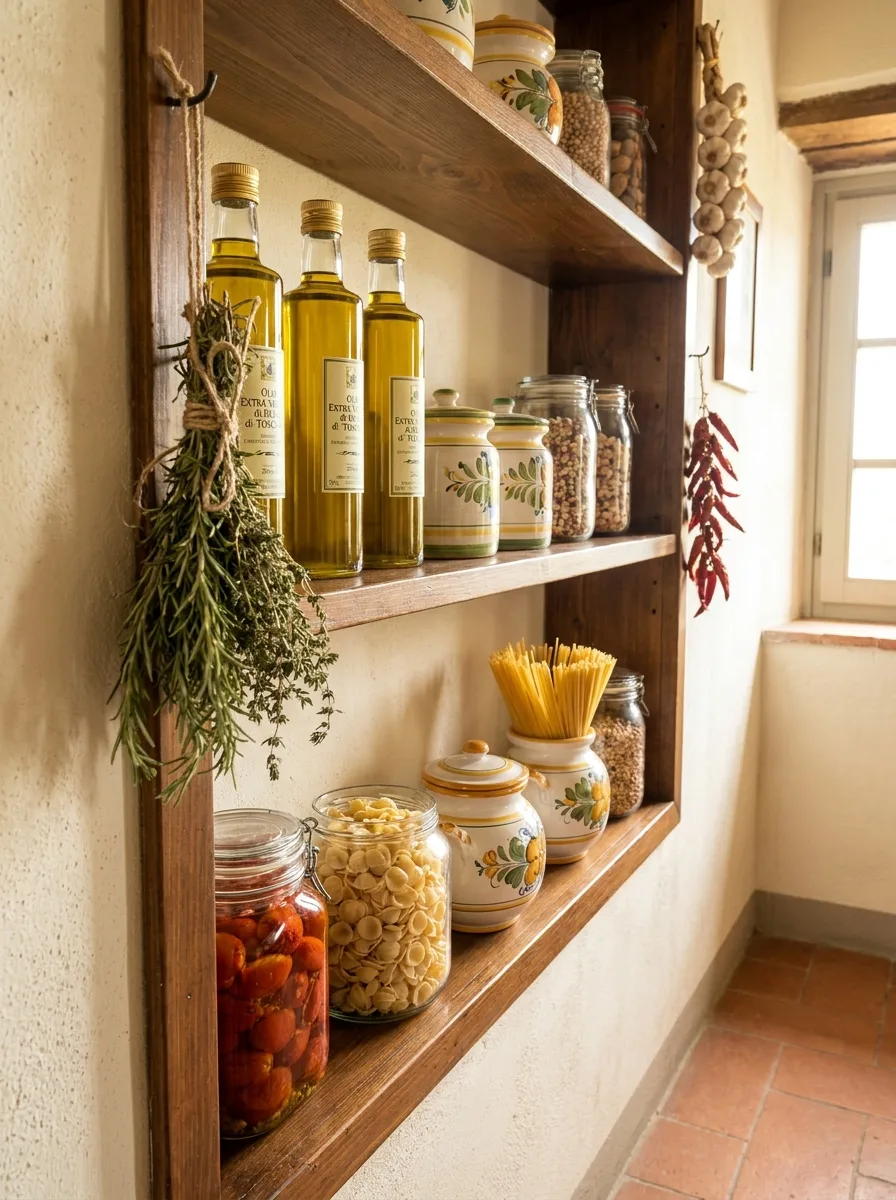
The Italian pantry is a form of hospitality — a display that says to any visitor: there is always something to eat here, always something to offer. A shelf of golden olive oil bottles, ceramic jars of dried pasta, preserved tomatoes in glass jars, and bundles of dried herbs is not just storage. It is a declaration of values: that food is important, that quality ingredients matter.
This display works visually because it combines warm golden tones — the olive oil, the dried pasta, the terracotta of ceramic jars — with organic textures and natural materials. The result is a corner of the kitchen that looks styled by someone who cooks rather than someone who decorates. It is one of the most widely saved details in Tuscan kitchen design: both aspirational and entirely achievable.
The Key: Buy beautiful containers once and decant into them consistently. The investment in ceramic jars and good glass olive oil bottles pays visual dividends every day — and costs less than any decorative object that serves no functional purpose.
16
Stone Accent Wall Fireplace
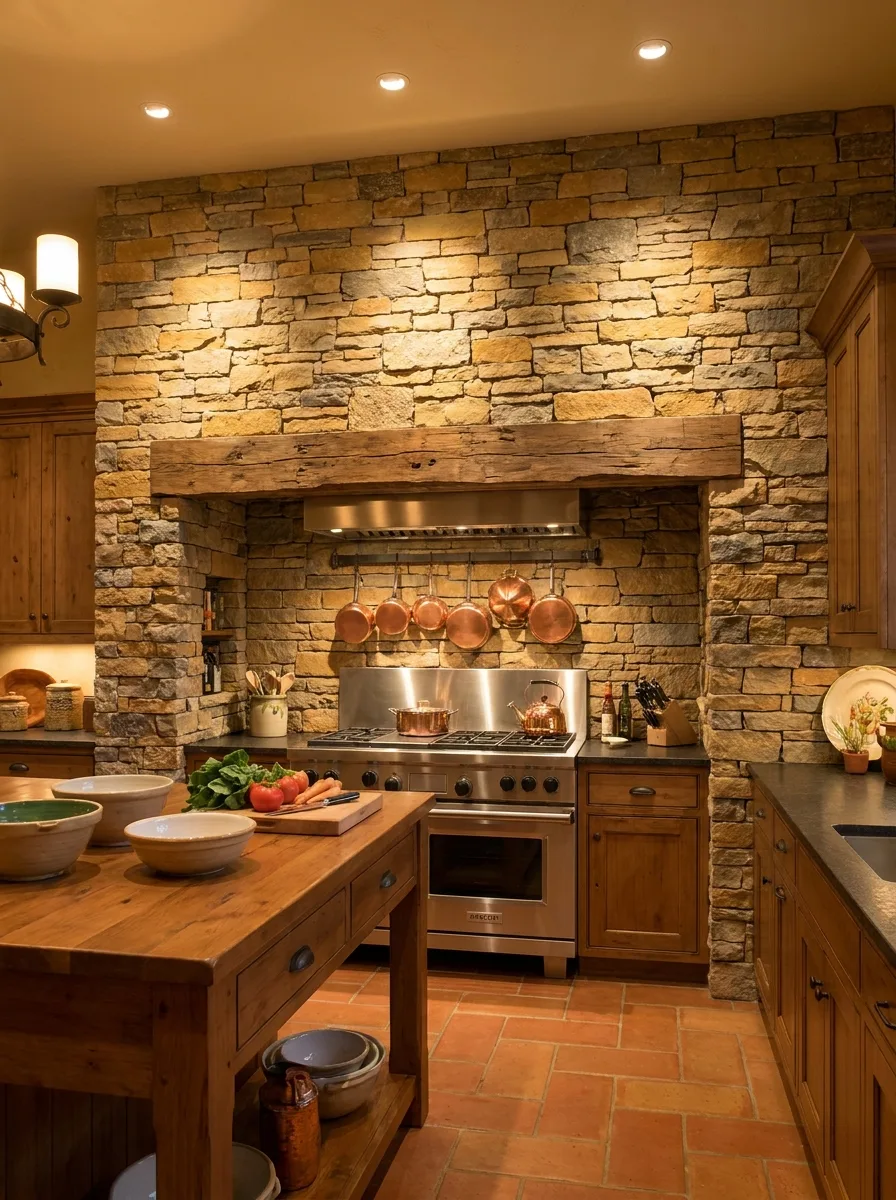
The stone wall in a Tuscan kitchen is a direct reference to the hearth — the central fire around which Italian farmhouse kitchens were organized for centuries. Before ranges and ovens, the stone fireplace was where all cooking happened: bread baked in the embers, polenta stirred slowly over the flame. A stone accent wall behind a modern range carries that culinary history into the contemporary kitchen.
The warmth of the stone’s color matters considerably. Honey-toned fieldstone, warm limestone, and cream travertine all work within the Tuscan palette. Grey slate or cool-toned granite do not — they introduce a temperature that conflicts with the warm, sun-soaked character of everything else in the room. Cool stone disrupts the entire palette and the conflict is immediately visible.
The Key: Choose stone in warm, honey, or cream tones. The right stone, lit by warm light and flanked by copper and wood, becomes the room’s most powerful architectural statement.
17
Linen and Embroidered Textiles
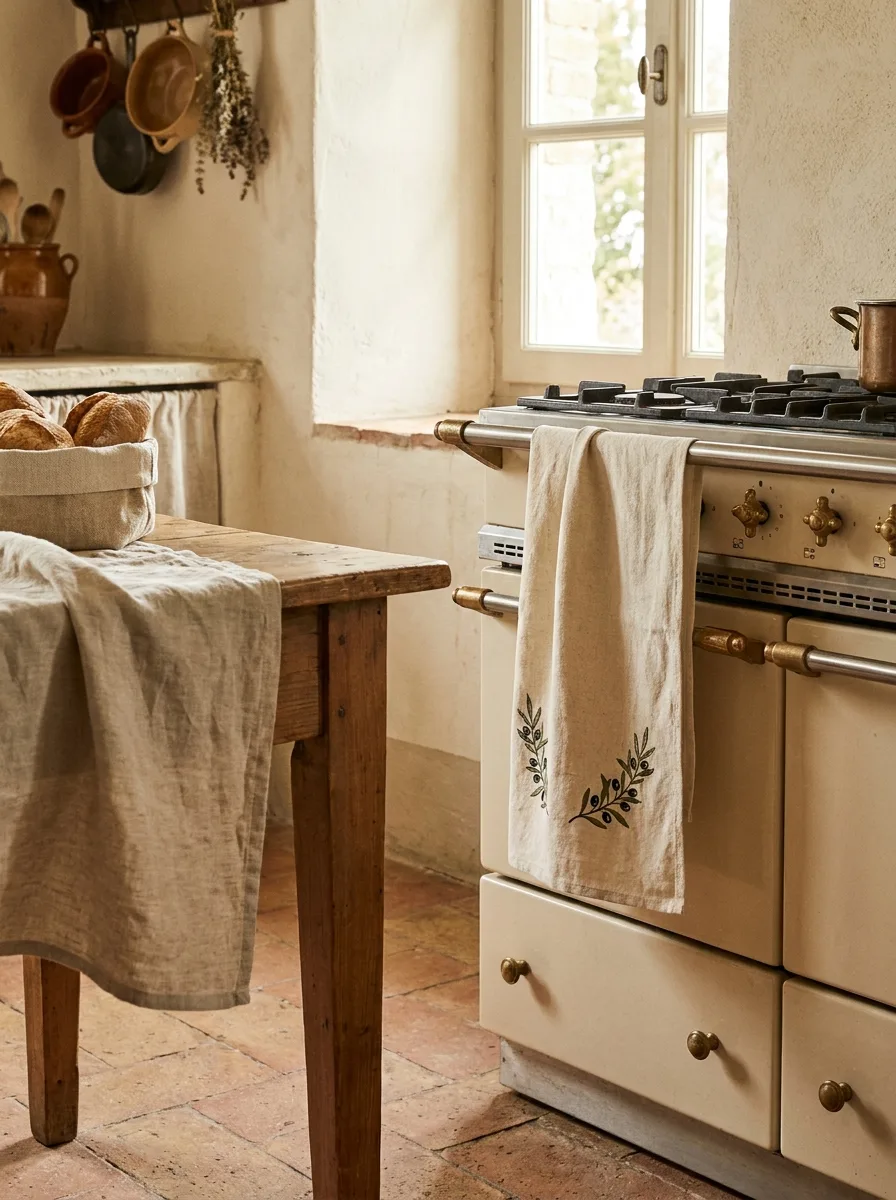
Textile quality in an Italian kitchen is a quiet but consistent signal of a household that cares about beauty in everyday life. The linen apron hung on the back of the door, the embroidered cloth used to cover rising bread dough, the table set with washed linen — these are small daily choices that accumulate into a way of living. In a Tuscan kitchen, textiles are functional objects that happen to be made beautifully.
The embroidery detail deserves special attention. A simple motif — olive branches, grape vines, a repeating geometric border — worked in natural thread on cream linen connects the textile to the visual vocabulary of Italian craft tradition. It references the embroidered linens of Italian households once made by hand for generations. Even a single piece of quality embroidered linen introduces handcraft and heritage into the space with remarkable impact.
The Key: Choose functional textiles that are also beautiful. In a Tuscan kitchen, there is no separation between the two — a linen towel should be as pleasing to look at as it is effective to use.
18
Aged Wood Dining Table
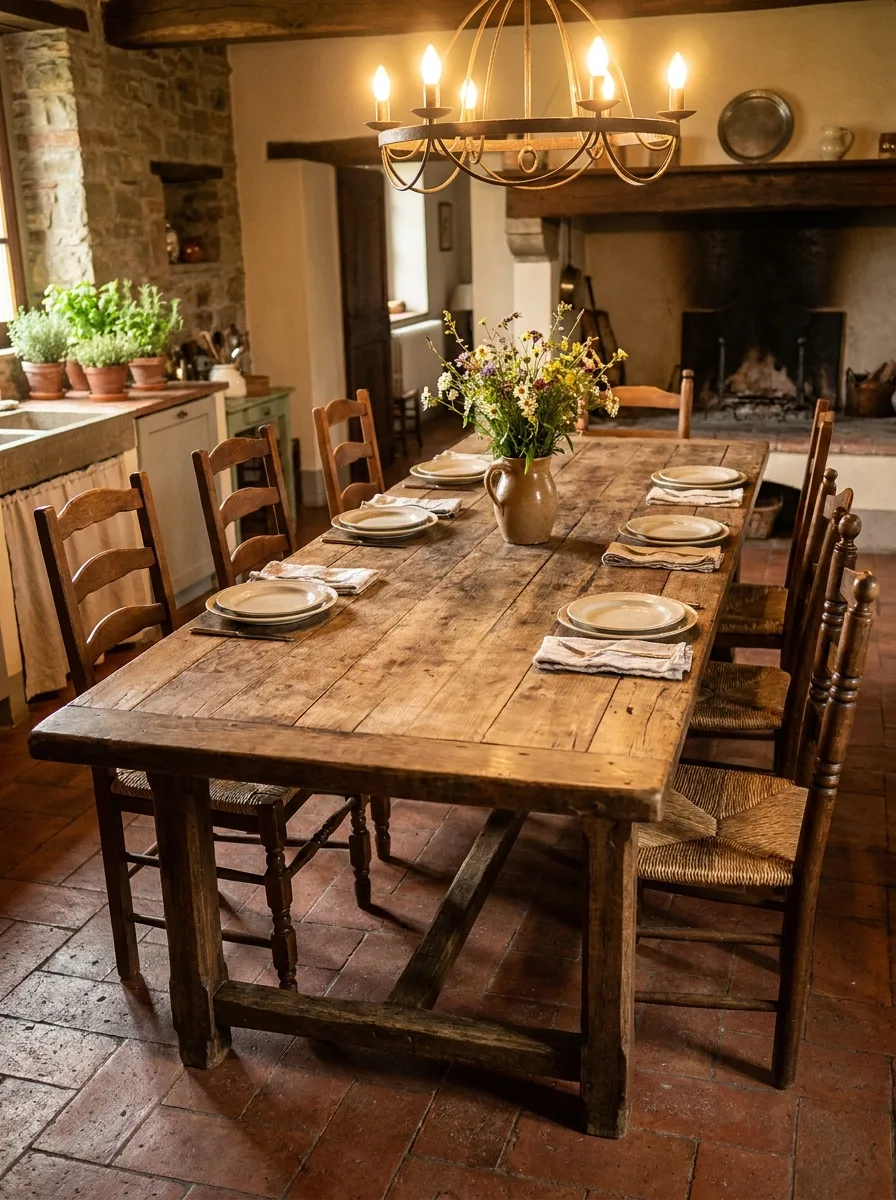
In Italian culture, the kitchen table is not simply where food is eaten. It is where life happens — where homework is done, where arguments are settled, where recipes are shared across generations, where friends sit for three hours after the meal because leaving would feel wrong. The large farmhouse table at the center of a Tuscan kitchen is an architectural expression of this value.
The aging of the table is what gives it its authority. A brand-new dining table, however well made, looks temporary. An aged oak table — with the marks of previous meals, the smoothed edge from decades of hands resting on it, the slight unevenness from years of seasonal expansion — looks like it belongs to the room. A genuinely old farmhouse table becomes the most important piece of furniture in the entire house almost immediately.
The Key: Size generously and age authentically. A large, well-used farmhouse table in a Tuscan kitchen communicates the Italian value of generous hospitality more powerfully than any decorative element in the room.
19
Overhead Rack Dried Herbs
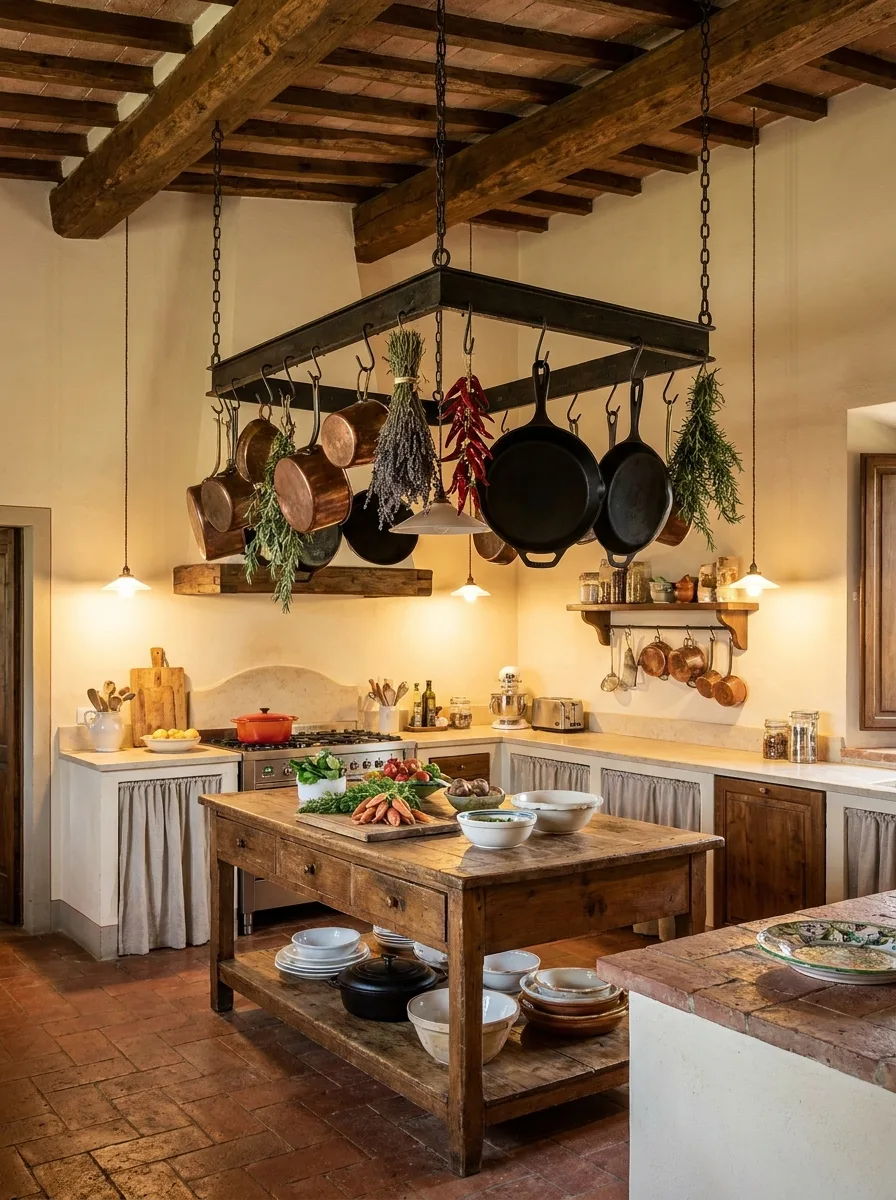
The overhead rack in a Tuscan kitchen is where the room’s culinary life is most visibly on display. Copper pots in various states of use, cast iron pans darkened by years of heat, bundles of dried herbs hanging alongside — together these elements create a display that is simultaneously a pantry, a pot storage system, and one of the most beautiful visual compositions in any kitchen aesthetic.
The dried herbs alongside the cookware separate a Tuscan kitchen rack from a merely rustic one. In a real Italian farmhouse kitchen, herbs are dried where they are convenient — above the cooking area, where the stove’s warmth aids the drying process. Hanging them alongside the pots is not a styling decision. It is a functional practice that happens to look extraordinary. Even two or three bundles of dried herbs transform a pot rack into a genuinely Italian kitchen moment.
The Key: Let the rack look lived in. The goal is not a perfectly arranged overhead display — it is an honest record of a kitchen that cooks Italian food regularly, with all the tools and ingredients kept close at hand.
20
Natural Wood Cabinet Doors
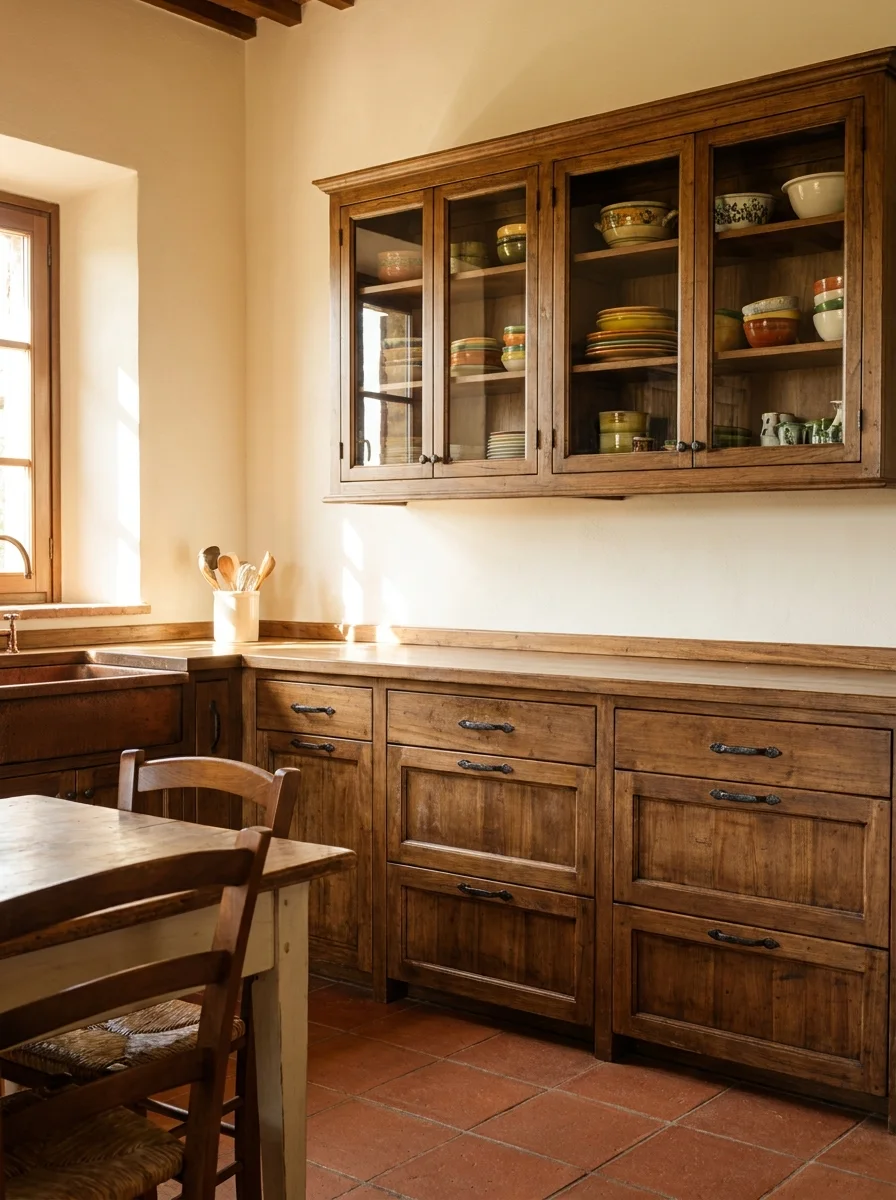
Wood cabinetry in a Tuscan kitchen is not painted or lacquered — it is stained or oiled to reveal and celebrate the grain beneath. This is a fundamental distinction from painted Shaker cabinets or lacquered European contemporary fronts. In a Tuscan kitchen, the wood is the point. Its warmth, its grain pattern, its slight variation in tone from door to door — these are qualities to be emphasized, not concealed.
A slightly distressed finish — through age and actual use or through deliberate hand-distressing — adds the character that makes a Tuscan cabinet look genuinely old rather than newly installed. The goal is a surface that looks like it has been in this kitchen for decades, opened and closed by many hands, cleaned many thousands of times, and developed its character through all of that.
The Key: Show the grain, celebrate the wood, and allow the finish to develop over time. Tuscan kitchen cabinetry is defined by the honest beauty of its material — any treatment that conceals that material works against the aesthetic.
21
Vintage Italian Artwork Prints
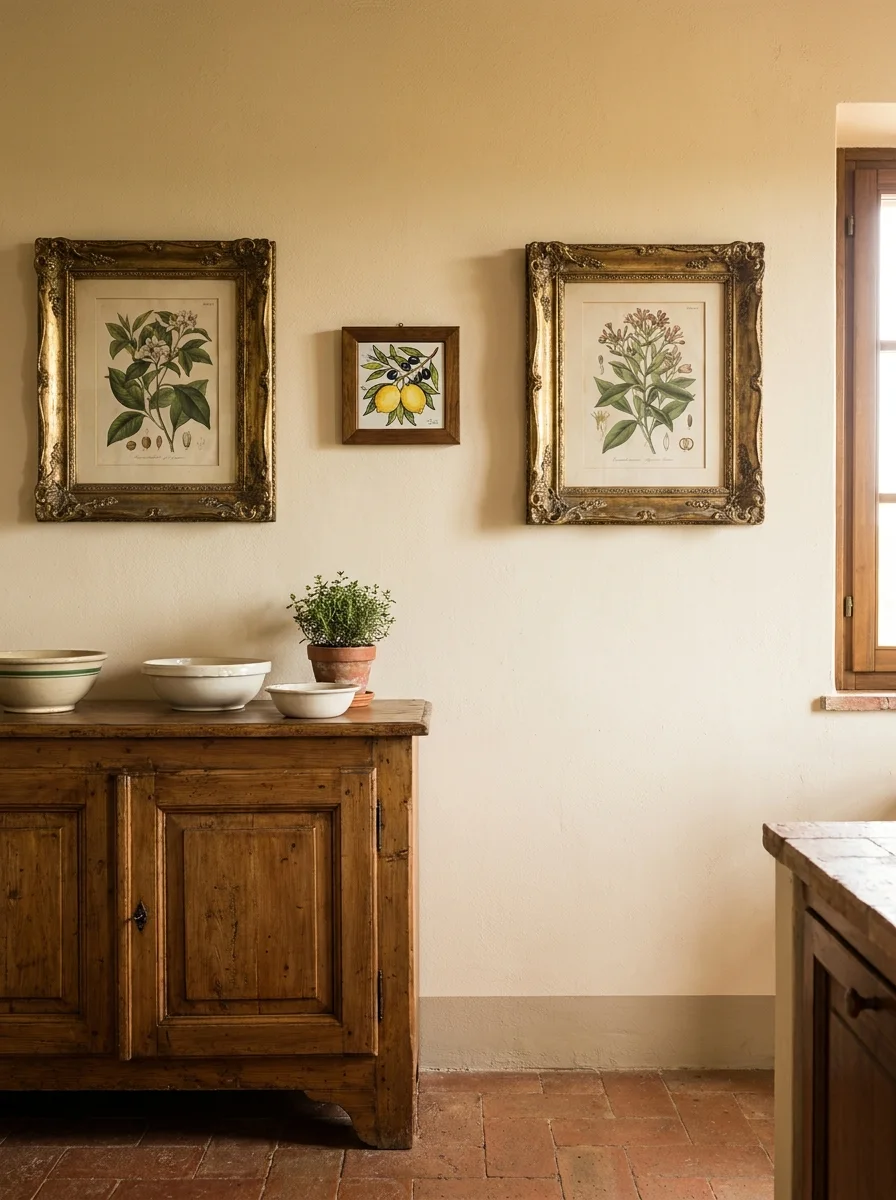
Art in a Tuscan kitchen is rooted in place, in natural history, and in food culture. A vintage botanical print of an olive branch, an old map of Tuscany, a reproduction of a Renaissance still life featuring Italian abundance — these are images that belong in a room dedicated to Italian cooking in the same way agricultural tools belong in a barn. They are thematically and aesthetically coherent with everything around them.
The frames matter as much as the prints themselves. A vintage Italian botanical print in a plain white frame looks like a mistake. The same print in an aged gilt frame with slightly damaged gilding, or in a dark walnut frame with a narrow linen mat, looks like it has been in the family for generations. The right framing can transform a reproduction print into a piece that visitors consistently assume is a genuine antique.
The Key: Frame with warmth and age. Gilt, walnut, and aged finishes transform even modest prints into pieces that feel like family heirlooms — and in a Tuscan kitchen, that quality of inherited, accumulated beauty is exactly right.
22
Bell Jar Cloche Food Display
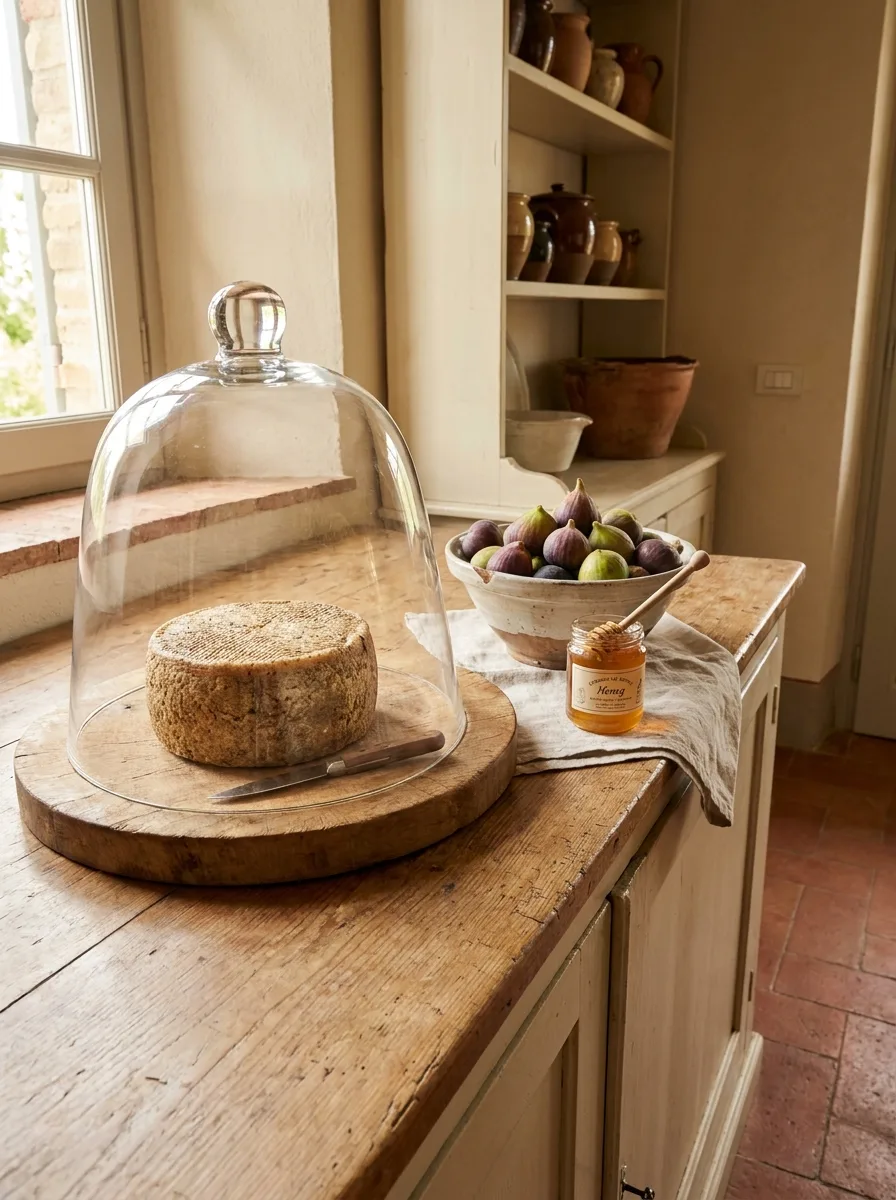
A glass cloche over food is a small act of Italian domestic theater — it says that what is inside is worth protecting and worth displaying simultaneously. In a Tuscan kitchen where the countertops are already beautiful, a bell jar display over aged pecorino or seasonal figs adds a final layer of food culture and generous abundance that brings the whole room to life.
The choice of what goes under the cloche matters enormously. It should be food that is beautiful in itself — a wedge of aged Parmigiano, a cluster of deep purple grapes, a small honeycomb beside raw honey. The food is the art in this display, and the cloche is its frame. This one counter element is among the most frequently photographed details in a Tuscan kitchen, capturing the Italian relationship with food as pleasure, beauty, and gift.
The Key: Display food as art. A glass cloche over beautiful, seasonal food on a warm wooden board is both the most functional and the most culturally resonant styling detail possible in a Tuscan kitchen.
23
Rustic Open Fireplace
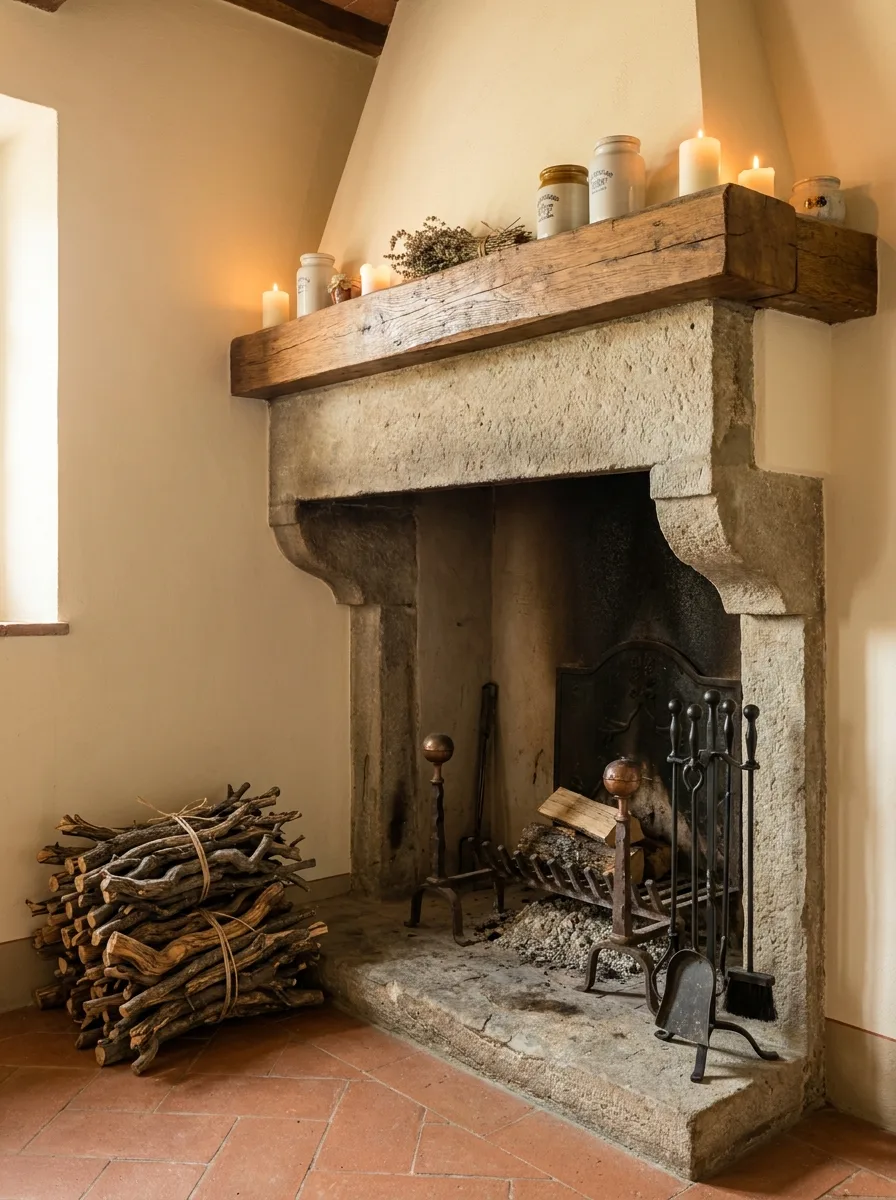
The fireplace is the oldest ancestor of every modern kitchen. In the Tuscan farmhouse tradition, all cooking happened at the hearth — bread baked in the stone-domed oven, beans slow-cooked in ceramic vessels in the embers, the kitchen’s warmth literally emanating from this central source of fire. Including a fireplace or bread oven reference in a contemporary Tuscan kitchen is an acknowledgment of where the kitchen comes from.
A non-functional fireplace surround can deliver most of this impact without the complexity of a working hearth. A stone or plaster surround, a thick wooden mantel, a cast iron grate, and a stack of split olive wood beside the opening — these elements together create an architectural moment of such warmth and historical depth that the room immediately feels rooted in centuries of culinary tradition.
The Key: Whether functional or decorative, a fireplace in a Tuscan kitchen is the room’s ancestral anchor. It references the origin of cooking itself — fire, stone, warmth, nourishment — and grounds the entire aesthetic in something far older than design style.
24
Vintage Scale and Copper Tools
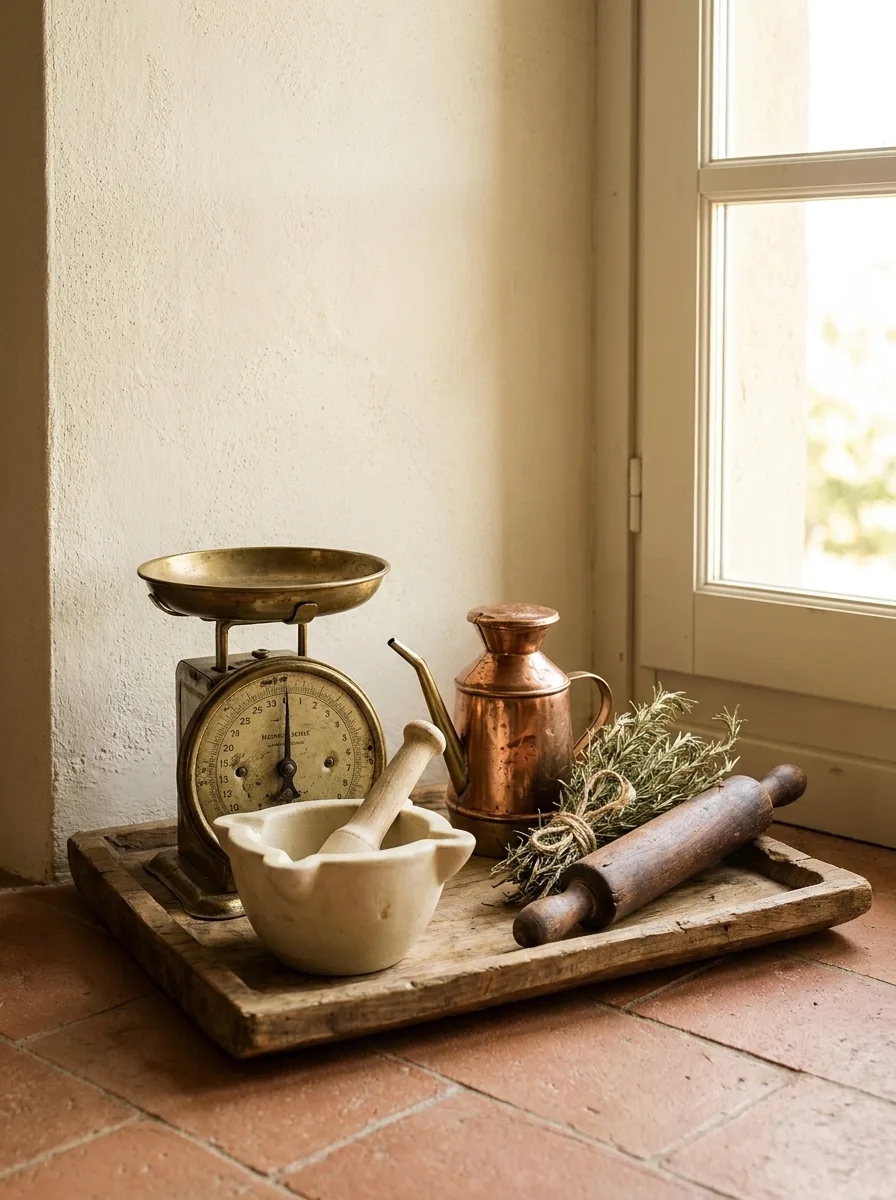
A display of beautiful, aged kitchen tools communicates a cooking philosophy as clearly as any words — that the kitchen is a place of craft, pleasure, and serious attention to making food. The vintage brass scale that measures flour with the same weighted counterbalance it has used for a hundred years, the stone mortar worn smooth from grinding garlic into pesto — these are tools with histories, and those histories give them weight and presence.
The functional requirement is important. A Tuscan kitchen does not display objects that are not used. Every tool on this counter should be genuinely part of the cooking practice — reaching for the mortar and pestle, lifting the olive oil can to dress a salad, using the rolling pin for pasta. The beauty of the display comes entirely from its honesty: these are real tools for a kitchen that really cooks.
The Key: Display only what you use. A collection of beautiful, genuinely functional vintage kitchen tools is one of the most honest and most characterful styling decisions available — because its beauty is entirely earned through use.
A Tuscan kitchen is not built in a weekend — but it is built one beautiful decision at a time. A terracotta tile floor here, a copper pot hanging from a beam there, a shelf of hand-painted ceramics that catches the morning light. Each element adds a layer of warmth and authenticity that compounds with every addition, until the room stops feeling like a kitchen that was designed and starts feeling like a kitchen that was lived in and loved.
These Italian Tuscan kitchen ideas are not a prescription — they are an invitation. Take what speaks to you, start with the one detail that feels most achievable, and build from there. The Italians have always understood that the most beautiful things are made slowly, with care, using honest materials. Your kitchen can be exactly that.
Save this to your Pinterest board and come back whenever you are ready for the next step. Share it with someone who deserves a kitchen that feels like a sun-warmed afternoon in the Tuscan countryside.